Window light is often the first beautiful light we notice as photographers—and sometimes the first to frustrate us.
One moment it can be soft and glowing; the next, it slips quickly into deep shadow. The same window that creates a sense of calm and intimacy can just as easily hide detail, especially on the side of the subject turned away from the light.
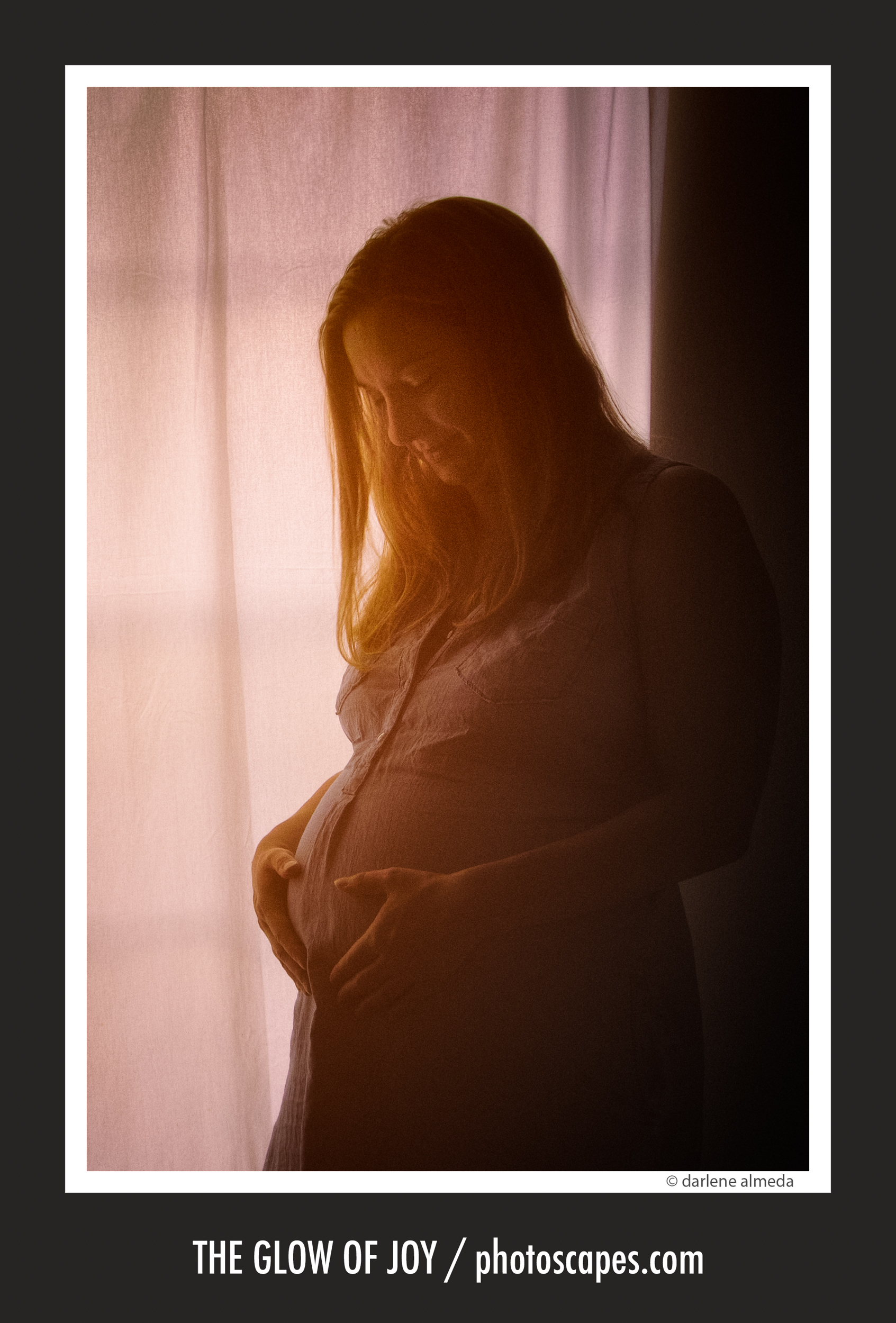
This image was made using window light diffused through a sheer curtain, with a gold reflector held just out of frame to gently return light to the shadow side of the face. The intention was a classic mother-in-waiting portrait.
What the Image Is Teaching
What to notice:
- Direction: Light is coming from one side only, defining the face through contrast.
- Fill: Light is gently reflected back into the shadow side of the face.
- Quality: The light is soft, diffused by the sheer curtain.
- Falloff: There is a rapid transition from highlight to shadow.
- Mood: Intimate, quiet, and inward.
None of this is wrong. In fact, this level of contrast is often exactly what we want. But there are times—especially in portrait and still-life work—when we want to support the shadow side without sacrificing the mood. In this case, a gold reflector was used to gently return warm light to the shadows, preserving both detail and atmosphere.
Introducing Secondary Light
Concept First, Gear Second
Step 1: The Idea
When we add fill, we’re not replacing the window light—we’re responding to it. The window remains the main light; the fill simply determines how much of the shadow we choose to keep.
Fill is not about making the scene brighter. It’s about deciding how much information lives in the shadows.
Step 2: Fill Card / Reflector
- Placed opposite the window
- Returns light already present in the scene
- Softens contrast without changing light direction
- Easy to adjust by moving closer or farther away
A simple white card or reflector placed just out of frame can make a dramatic difference. Move it closer and the shadows lift; move it farther away and contrast returns. This is the simplest and most effective way to see what fill does—without introducing additional complexity.
Still Life Demonstration: Fill-Light Sequence
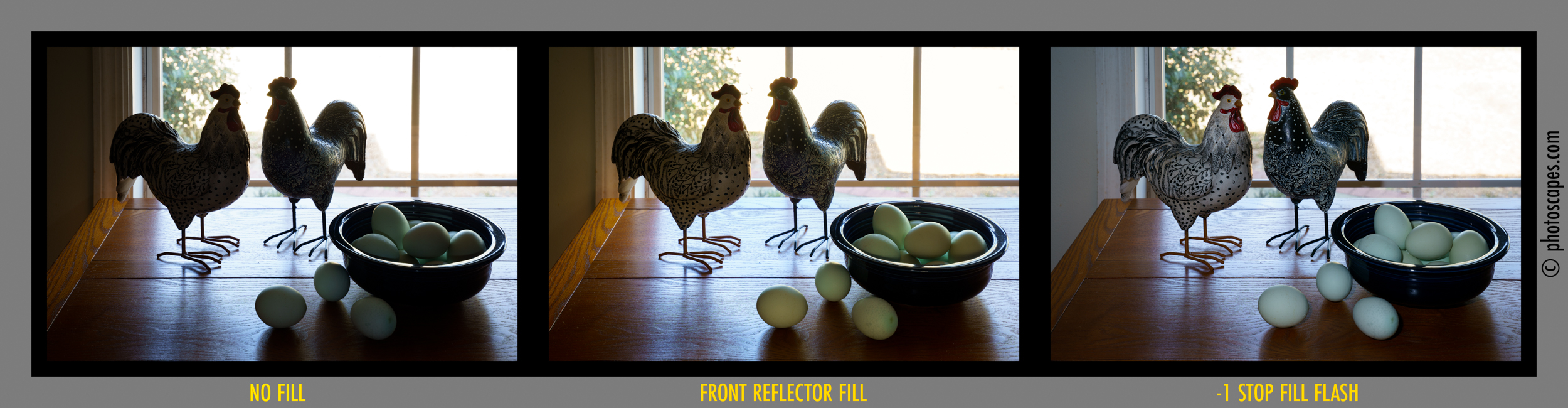
Morning Watch: working the fill light
Setup
- Two chickens, bowl of blue eggs
- Placed in front of window
- Camera facing the shadow side
Image Sequence
- Window light only: Deep shadows, strong mood
- Window light + reflector: Shadow detail returns
- Window light + -1 stop flash: Better, but it still looks like flash—and that’s not the goal here.

Notice the brightness from the mirror
Still life is an ideal way to learn window lighting because nothing moves, and the light itself becomes obvious.
Now that we’ve seen what fill does visually, let’s talk about how to control it.
Introducing Fill Light & f-Stops
When window light establishes your main exposure, any fill light you add should be set lower—often one or two stops less. You’re not trying to light the subject from the front; you’re simply lifting the shadows enough so the viewer can see what matters.
Looking at the fill-light sequence above, Image #2 feels natural because a silver reflector was used to lift the shadows while preserving the color and character of the existing light. In Image #3, the flash output is too strong—most of the scene is evenly lit, and the result feels flat and unnatural.
Flash can easily look harsh or bluish, especially in a scene dominated by soft window light. But it doesn’t have to. With a little control, it’s possible to blend the qualities of Images #2 and #3—retaining the color and mood of the ambient light while using flash only to support the shadows. That balance often gets us closer to better—at least when the goal is atmosphere rather than simply making everything visible.
There’s a technique I often use with a handheld flash to gently lift shadows while still capturing the color of the existing light. Before getting into that, it helps to understand one important thing about flashes (or speedlights): they are measured in f-stops.
If your lens is set to f/8 and you want full flash exposure, the flash would also be set to f/8. For fill, however, the flash should be reduced—typically by one or two stops. That means setting the flash to f/5.6 or f/4, or using a corresponding power level such as 1/2 (50%) or 1/4 (25%) power, depending on how your flash is designed.
While TTL flash works beautifully for candid and event photography, I prefer using flash in manual mode for fill. It’s predictable, repeatable, and keeps the balance intentional rather than reactive.
One caution: automatic settings can be misleading. If accuracy matters, use a flash meter to confirm the actual output of your flash. It’s the quickest way to know whether the numbers you’re seeing reflect reality—or are simply optimistic guesses.
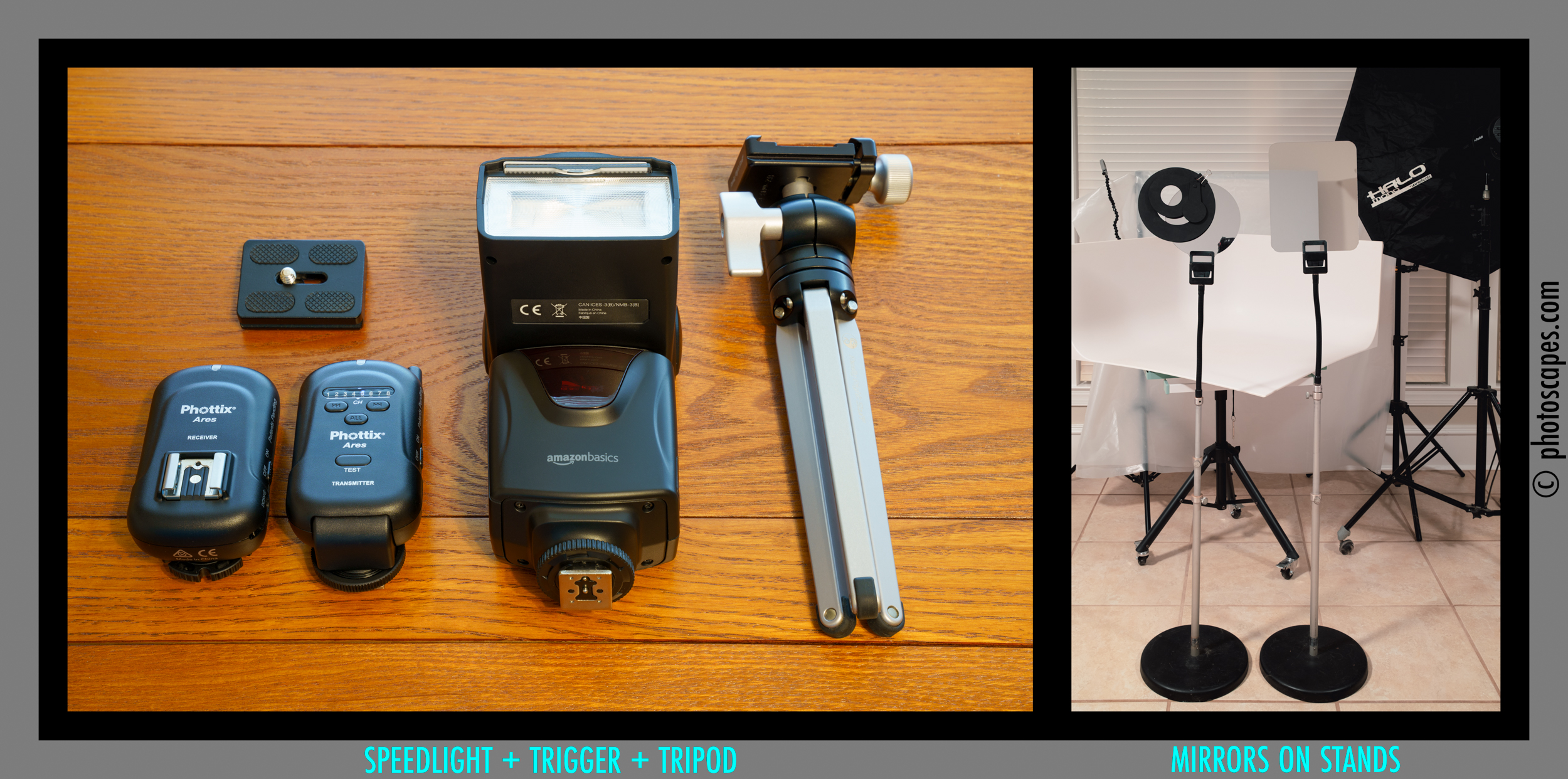
A Practical Fill-Flash Technique: Dragging the Shutter
The fill-flash technique I’m using here comes from what we used to call dragging the shutter. It’s a method I relied on throughout my career, and one of the reasons I worked almost exclusively with Hasselblad leaf-shutter lenses.
With a leaf shutter, flash will sync at any shutter speed, which makes blending ambient light and flash incredibly flexible. That flexibility shaped how I think about balancing light—even when I’m not using a leaf shutter.
For this example, however, I did not use a Hasselblad. Many of my readers don’t work with leaf-shutter lenses, so I want to show how the same approach can still be used with a focal-plane shutter—specifically with my Sony A7R IVA.
Step 1: Decide on Depth of Field
The first decision has nothing to do with flash.
I look at the scene and decide how much depth of field I want. In this case, I chose f/11. That choice stays fixed throughout the process.
Step 2: Establish the Ambient Light
Next, I decide how I want the ambient light to look. Do I want it bright and open, or am I after mood and atmosphere?
Here, I’m after atmosphere.
I take a meter reading from the far wall on the left side of the window and decide that I want it to fall 1 to 1.5 stops darker than the window itself. This keeps the room from going flat while preserving detail outside the window.
The shutter speed that gives me that balance is 1/2 second. At this speed, the ambient light retains its color and the window doesn’t blow out completely. I want to see the hint of greenery outside—not a white rectangle.
At this point, the ambient exposure is locked in.
Step 3: Set the Fill Flash
Now that I know:
- Aperture: f/11
- Shutter speed: 1/2 second
I set the speedlight for fill—not as a second main light.
That means reducing the flash output by about one to two stops, which translates to:
- f/8 to f/5.6, or
- 50% to 25% power, depending on the flash design
This gives me shadow detail without flattening the scene.
A Note About the Speedlight
The speedlight I’m using here is nothing fancy. I keep a few inexpensive ($25) speedlights in my kit for situations like this—on-location scenes where the ambient light is beautiful, but a foreground subject needs just a touch of lift.
This particular flash has eight power levels, but it’s not especially powerful. That’s fine for small still-life fill work.
I strongly recommend using a flash meter to test your speedlight so you know the maximum f-stop it can produce. Always use fresh batteries, and avoid firing the flash directly from the camera.
For this setup:
- The flash is mounted on a small tripod
- Triggered wirelessly with a simple transmitter/receiver
- The transmitter sits on the camera hot shoe
- The flash is handheld as I shoot
This keeps the light flexible and directional.
What If You’re Not Using a Leaf Shutter?
With a leaf shutter, flash sync at any speed is a given. But what if you’re using a focal-plane shutter, like I am here?
The Sony A7R IVA syncs flash at 1/250 second, but it also offers Slow Sync Flash, which allows flash to be used at much longer shutter speeds—up to 1/2 second in this case.
If your camera doesn’t offer slow sync, there’s another option.
Handhold the flash and press the test button during the exposure. It may take a few tries to get the timing right, but it works—and produces the same blending effect. I’ve used this technique many times with flashes that would not sync with my cameras.
Final Camera and Lighting Settings
For the final image:
- Aperture: f/11
- Shutter speed: 1/2 second
- Flash: –1 stop (approximately f/8 equivalent)
- Reflector: kept in place to support the eggs
The result preserves the color and mood of the soft ambient light while gently lifting the shadows—nothing looks flashed, and nothing feels forced.
That balance is the goal: not a perfectly lit object, but a photograph that holds atmosphere, depth, and intention.
Morning Watch
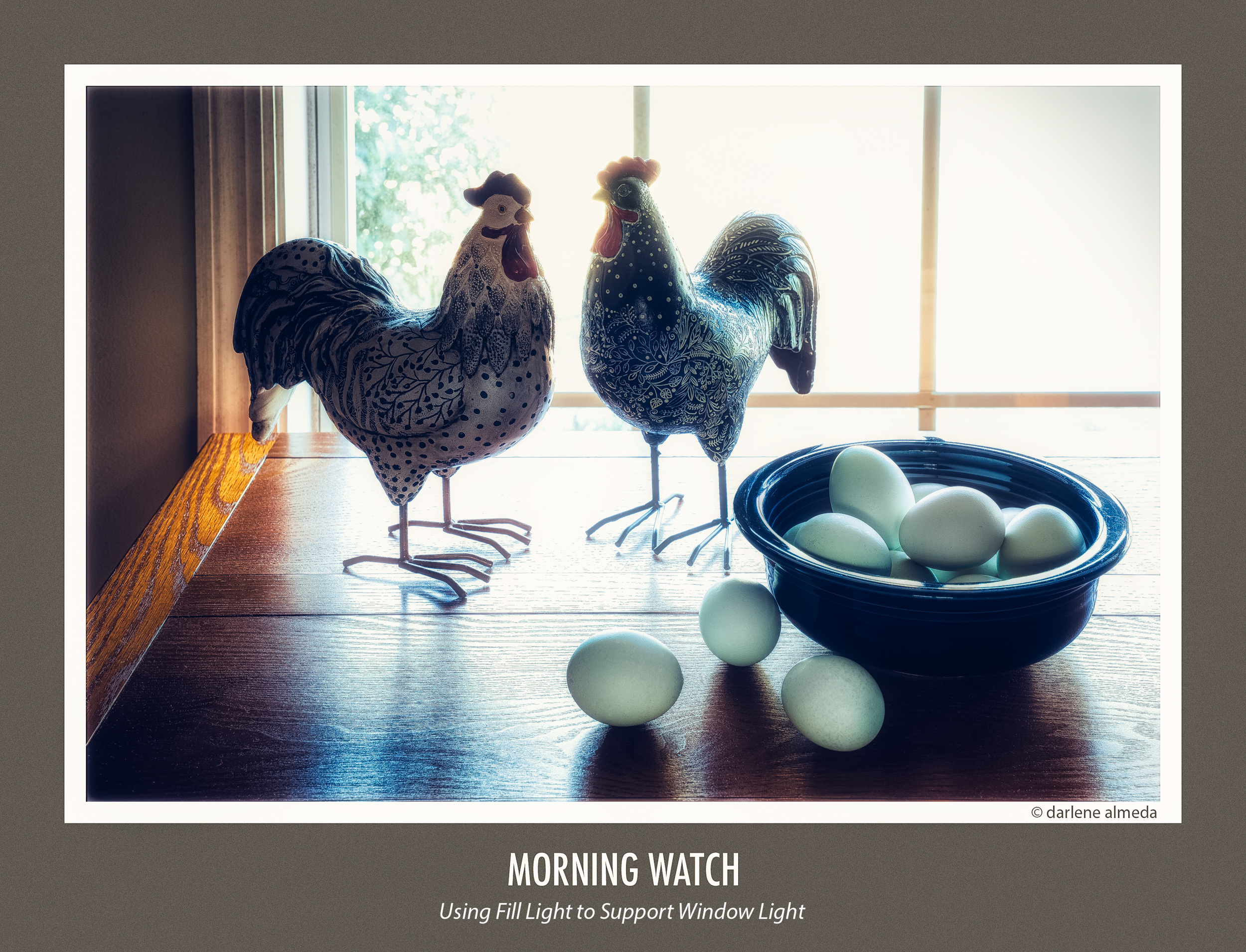
Window light is generous, but it doesn’t do everything for us. Learning when to leave it alone—and when to support it—is one of the most important lighting skills a photographer can develop.
Up next, we’ll focus on understanding shadows, because shadows are the direct result of every lighting decision we make—and the clearest clues to how light is truly working in a scene.