
INTRO
In the past, I used Hasselblad V cameras on shooting sets with multiple magazines, some with 120/220 color film, others with 120 B&W, another for Polaroid shots to test the color temperature or direction of lighting, and lastly, many special event jobs required using 70mm magazines. I like the convenience of switching different magazines, viewfinders, screens, etc., and I appreciate Hasselblad’s modular system as this deep dive into what I shoot continues to confirm this liking.
There are a few different-looking magazines for the V system, some that look different but function the same, and some that look different but do indeed operate a bit differently. I photographed three magazine backs for the above graphic to show some differences. Once you become familiar with the V system film magazines (backs), you can quickly distinguish what makes them different operationally.
C 12 MAGAZINE
The first photo in the graphic shows what is known as a “C” magazine. Hasselblad originally called it “Magazine 12” based on an early datasheet named “220 film.” It may have later earned the “C” designation for “classic” from photographers to distinguish it from the later “A” “automatic” film magazines.
You should understand why these particular non-automatic film magazines are popular today. For photographers like myself who enjoy shooting medium format film and digital, the “C” magazine can be used on a camera that takes a Hasselblad V digital back plate. Manual film advancement is required because these cameras lack the film advance mechanism built into a Hasselblad camera. The manual film advancement feature makes the “C” backs usable on some non-Hasselblad cameras.
On a “C” magazine, we use its rear peephole (covered with a circular metal plate in the photo above) to see the film frame numbers on its backing paper. This and the manual film advancing allow me to shoot 120 film on my ALPA cameras without needing to purchase an expensive, heavy, non-6×6 format ALPA-Linhof film magazine. I own two very clean “C” magazines manufactured in 1957 & 1967, and I added a Quick Winding Crank #41076 to each. Shortly after acquiring them, I had them rebuilt as needed and replaced all seals so they would last another 50 years. I use them on my Hasselblad and ALPA cameras with excellent results.
A 12 MAGAZINE
The second photo shows an older “A 12” magazine. According to the year dating code, this magazine was manufactured in 1972. This magazine has served me well over the years. A primary difference between this “A” magazine and the latest model, as shown in the above graphic (image #3), is the convenience of having a designated area to store the dark slide while shooting. There is little difference besides convenient dark slide storage and updated cosmetics. To my knowledge, the film gate produces the famous ‘two triangle cutouts’ (“V”s for Victor) on the left side of the film frame on all 120/220 Hasselblad film magazines. Instructions on how to load any of the “A” magazines can be found here.
A 24 MAGAZINE
The third magazine shown in the above graphic is of a late-model A24. I also own a late-model A12 that stays on my 501cm. When I shot special events, I once had six 220 film magazines. You can use 120 film in an A24 magazine, so I have kept mine (see below). You could buy these A24 magazines more reasonably than A12 because 220 film is no longer made, which is a bummer. I prefer the newest film magazines for the dark slide holder and better cosmetics.
POST: 120 FILM IN 220 MAGAZINE
HASSELBLAD VIEWFINDERS
IMAGE #1: PME51 #42296, WAIST-LEVEL #42315, RMFX #47070
PME51 (#42296)
The PME51 is my most used viewfinder (VF) when shooting the 501cm and 503cx cameras. The viewing angle is 45° to the vertical, and the focusing image is unreversed and magnified 3x. It has a centered-weight integral meter that is fast and accurate and is designed to be used with the Acute-Matte focusing screen. The operating knobs and buttons are countersunk, and the scales and indicators are behind windows to protect them from damage and the elements. It has a cold shoe on top that I installed a bubble level but will slip in a Profoto Air (remote trigger) when using the 501cm/503cx in the studio.
The PME51 uses a 6V PX28 battery, which I fulfill with a Duracell 28L 6V lithium battery. I highlight the 45° to the vertical above to remind folks this is not a 90° VF, but I do use it as such. I stand slightly to the side when I flip the camera to the vertical position (using a digital back) and get used to it. Even though I have a PM90 VF in the gear closet, I prefer the PME51 as my ‘daily viewfinder,’ so to speak. I found in photography; I can use gear that others seem to have conniptions over.
Below are instructions on how to meter with the PME51. I include this checklist because a few photographers who purchased their PME51 used without instructions were using it incorrectly. If you have a PME51 or plan on getting one for your 500 V camera, read over the checklist to see how you are supposed to use this meter, it might change how you shoot with it a little.
Operating the PME51:
- Readings must ALWAYS be taken with the LENS WIDE OPEN.
- Set the lens maximum aperture in the left side window.
- Set the ASA/ISO of your film, left of the lens aperture setting.
- Compose image, press meter start button; leave for ½ second is best.
- EV is displayed on meter’s EV scale underneath VF image for 10 seconds.
- Transfer EV reading to orange EV scale on right-hand side of lens.
- Adjust lens aperture to your shooting aperture. Repeat to memory.
WAIST-LEVEL FINDER (#42315)
The foldable Hasselblad waist-level finder (WLF) shields the focusing screen from stray light. It displays a full, upright, but reversed image even with the camera at hip level. It has a built-in magnifier that enlarges the image 4.5x, which I appreciate greatly. Hasselblad made interchangeable correction magnifiers ranging from -4 to +3 diopters for this finder, but I have never used one.
The best use I find for the WLF is in its folded position on the camera to protect the focusing screens while in storage and transport. I had used WLFs in the past during indoor shoots when my back was up against a wall, but I found it annoying if it was a group portrait session and having to remember, since the image is reversed, to look up and tell the subjects to go a little more right or left. If I did it while looking through the WLF, I would say the wrong direction 50% of the time. But truth be told, I find it better for this type of shooting (back up against the wall) than the Magnifying Hood #52096 (below).
I have a WLF for my ALPA cameras since I need to protect the Hasselblad ground glass I use with the ALPAs, and because the magnifier 4.5x is an excellent focusing tool. I love how Hasselblad gear will integrate with my ALPA gear, and up next is the viewfinder I use the most with my ALPA and FlexBody cameras.
REFLEX VIEWFINDER RMFX (#47070)
Designed for use on the SW/SWA/SWC and Flexbody cameras with the necessary focusing screens #41025 or #41050 (see below), the Reflex Viewfinder RMfx (RMfx) provides a comfortable working position from a 10° viewing angle. The RMfx has an enlarged eyepiece to provide a full-screen image for users with eyeglasses and displays an upright and non-reversed image. I used this viewfinder with the FlexBody and adapted it for use with my ALPA cameras for composing before shooting with a digital back or film magazine. The RMfx + #41050 setup is superior to anything ALPA has offered for viewfinder/ground glass options.
IMAGE #2: MAGNIFY HOOD #52096, SWC FOCUS SCREEN #41050, PM90 #42288
MAGNIFYING HOOD (#52096)
Better than the WLF for some photographers but not as convenient for others, the Magnifying Hood #52096 (MH) does not fold but does not take up too much space in a camera bag. It features an adjustable magnifying scope with a range of -3 to +3 magnification, and the image is upright but reversed, similar to the WLF. When my back is against a wall, this viewfinder can help, except I cannot see the entire image at a glance. I need to move my head around, from corner to corner, when looking through the MH, which is inconvenient.
Known to many photographers as the chimney viewfinder or hood, the #52096 can also be used as a critical focusing lens for the ground glass on my large format cameras and is perfect for viewing negatives or slides on the lightbox or contact prints. The only thing missing is a cord to wear around your neck. These are not expensive, and if you already have a WLF and are looking for a backup substitute that can also aid as a loupe for your view camera or film viewing, this might interest you.
SWC FOCUSING SCREEN/GROUND GLASS ADAPTER (#41050)
The SWC Focusing Screen Adapter (FSA) #41050 was made explicitly for the Hasselblad SWC and FlexBody cameras. It has a line grid and a split image rangefinder in the center. It is made with the same material as the Acute Matte screen. The top and bottom lines in the grid outline the borders of the 6×4.5 cm image format. The FSA attaches to the camera in the same way as a film magazine. It accepts all viewfinders of the Hasselblad V system. The older, similar model, #40125, is not made with the Acute Matte material. I had one, and because I was familiar with the brightness of the Acute Matte screen, I immediately noticed the difference and sought a replacement #41050.
Besides using #41050 on the FlexBody, I use it on my ALPA TC and SWA cameras, along with the Reflex Viewfinder RMfx. To do this, you must have an ALPA-Hasselblad digital back plate. Install the digital plate, then install the #41050 and any Hasselblad V viewfinder you choose. I sometimes walk around with my ALPA TC with the #41050 and RMfx, looking for compositions before shooting it with a digital back. It works well for my needs and is bright, making it easy to focus on.
PM90 (#42288)
The PM90 #42288 is a low-profile prism viewfinder that allows the photographer to see at the eye-level position of the camera. It is suited for switching between portrait and landscape composing and shooting. It has a 2x enlarged, unreversed image that covers the entire focusing screen. The large, easily interchangeable eyepiece is designed to provide eyeglass wearers with an image that is free from vignetting. Corrective power eyepiece replacements range from -4 to +3 diopters.
I find this viewfinder a pain to use with a digital back. It can be challenging to install and remove due to its low profile. It can also be difficult to install/remove with a film magazine, but this is less costly than a digital back. You do not want to risk the safety of an expensive digital back; that’s a lot of stress!
Here it is if you want a non-metering 90° viewfinder for your 500/200 series camera. I do not use the PM90 often enough to justify keeping it, as I have grown accustomed to shooting with the PME45 in portrait orientation.
IMAGE #3: PRISM NC-2, MAGNIFYING HOOD #72534, PRISM HC-3/70
PRISM FINDER NC-2
The NC-2 provides a 45° sighting angle about the lens’s optical axis. The view provided is an unreversed, 3x enlarged image on the focusing screen—the short light path of the NC-2 results in minimal light loss. I used the NC-2 for over a decade with my 500C and 500CM cameras at special events, portrait sittings in the studio, and in environmental settings. It served me well. If you’re looking for a non-metered 45° prism finder, this might be the right choice. Due to their age, I recommend purchasing from a reputable dealer with a clearly stated return policy if the mirror, glass, or overall condition does not meet your expectations.
MAGNIFYING HOOD 4×4 DPS (#72534)
The Magnifying Hood 4×4 DPS #72534 was designed to help users focus while utilizing a digital back on a Hasselblad V series camera, FlexBody, or a Hasselblad digital back on a view camera. They were recommended for use with a 37mm x 37mm sensor area (and were marginally usable for the 44mm x 33mm sensor of CFV-50C and other digital backs). I have a digital sliding back, made by Kapture Group (now defunct), for my Sinar Norma + Hasselblad V digital back, which came with this magnifier hood. It does a good job, but I no longer need it because of having Live View with the CFV II 50c.
PRISM FINDER HC-3/70 (#52043)
Designed for use with the larger A70 film back and a V-series camera, the HC-3 features a 45 ° sighting angle about the lens’s optical axis. The view provided is an unreversed, 4x-enlarged image on the focusing screen, and the HC-3’s eyepiece is adjustable ± 5 diopters. I used this viewfinder for over a decade while shooting 70mm at special events. It was a lifesaver if you shot 70mm, which many photographers did not. Back then, I would purchase 100-foot rolls of Kodak VPS III film and load it into 70mm cassettes. Kodak Portra is what VPS III evolved into. I am unsure if this viewfinder is still necessary today, given the availability of 70mm film and the need to use an A70 magazine. You could still use it, but it might look a bit awkward.
HASSELBLAD ACCESSORIES
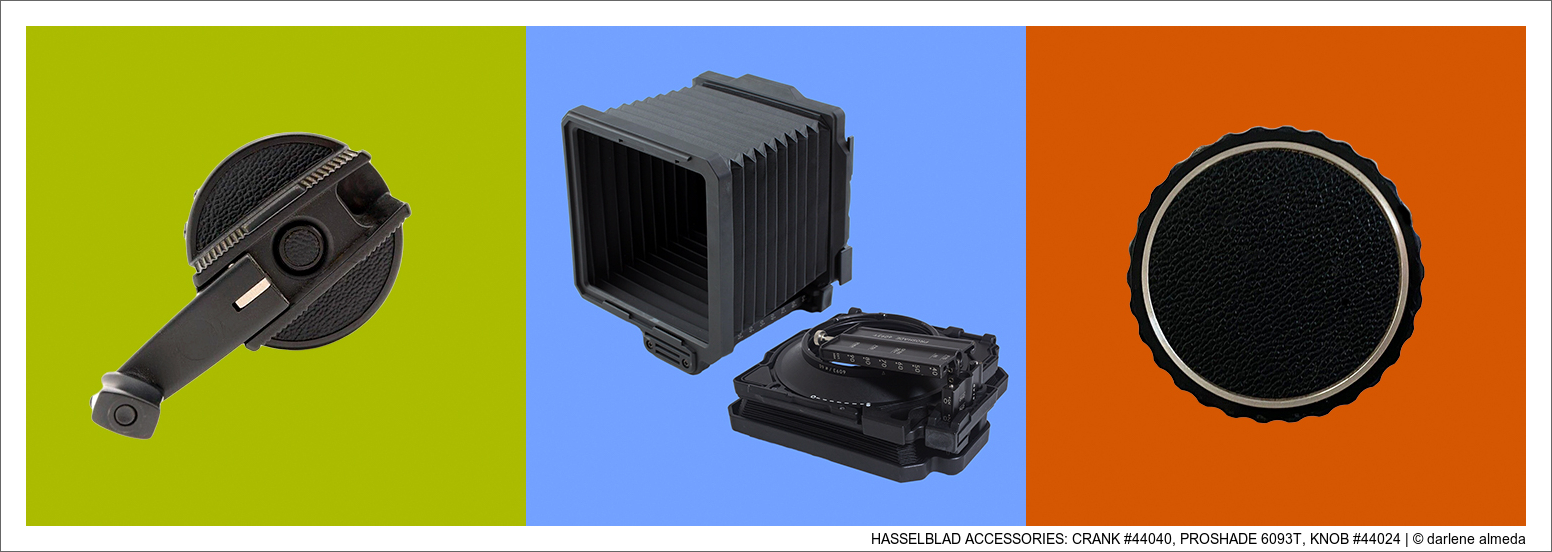
IMAGE: HASSELBLAD CRANK #44040, PROSHADE 6093T, KNOB #44024
RAPID WINDING CRANK #44040
The Hasselblad winding knob on the 500 series cameras can be replaced with a Rapid Winding Crank for faster film winding. It increases shooting speed and advances the film quickly and smoothly. Marketed as an excellent advantage for studio, fashion, and wedding photographers, but realistically speaking, it is beneficial for all types of shooting, unless the mounting of your camera prevents its usage, which is why it was removed on my 503cx (more below). If your V series camera did not come with one (originally sold as an accessory), I recommend it for its easier grip and faster film winding.
PROSHADE 6093T
A versatile lens tool, the Hasselblad Proshade 6093T bellows lens shade/hood is a handy accessory. It fits all Hasselblad lenses, from 38mm to 500mm, using the various adapters available. It gives you total control over the lens shading and prevents image degradation from stray or direct light on the lens surface. The 6093T can be used with various types of filters. Bayonet filters mount on the front of the lens and can be changed without detaching the 6093T. Hasselblad, 93mm filters, go behind the 93mm lens adapter, and the 93mm Polarizing filter can be operated with the 6093T attached to the lens.
The rear filter holder accepts 100mm square resin, glass, or gelatin filters, and multiple filters with a total thickness of 4mm can be inserted simultaneously. The rear holder drops down and out of the way when needed. This is a deal-maker for anyone like me who uses 10± ND filters, such as Lee’s Big Stopper series of filters. Find your composition, load the filter, and drop the rear holder so you can see through the lens. Ensure the focus is still where you want it, then push the rear holder back up and shoot.
I like all of the above, plus it folds! My preference for single-lens hoods, especially those made of rubber, is no secret. However, when I need to use filters while shooting, this is my hood of choice. It takes up hardly any room in my travel pack, and I would keep one in my gear closet even if I did not use it as often as I do with 100mm filters. If you want a Proshade for your Hasselblad, seriously consider the 6093T. You can view the Proshade 6093T user manual here.
WINDING KNOB #44024
The Winding Knob #44024 is the standard knob with all-new V-series cameras. My 501cm and 503cx had Rapid Winding Cranks (RWC) installed when I purchased them. I prefer the RWC except when my digital V, the 503cx, is used with my panoramic setup. When the 503cx is placed sideways and in the vertical position for making pano slices with my Fotopro E-6 Gimbal, the RWC is too difficult to grab onto because there is not enough room between the RWC and the tripod—this issue can be easily fixed by installing the Winding Knob #44024.
HASSELBLAD V PINHOLES
IMAGE: CUSTOM CAMERA BUILDING HASSELBLAD PINHOLE CAP & PINHOLES
CCB V PINHOLE CAP & PINHOLES
The Custom Camera Building (CCB) Hasselblad Body Cap & Pinholes should be on your shopping list if you enjoy pinhole photography and own a Hasselblad 200, 500, or 2000 series camera.
My initial feelings about shooting a pinhole negative less than 6x17cm or 4×5″ were not very positive. My thoughts drifted toward the added blurriness a smaller negative might produce. Pinhole images are already unsharp, but just enough that I like them. I assumed shooting a pinhole with a smaller film frame might cause the image to be less likable due to more blur. Boy, was I surprised. Not only were my images artistically fulfilling with the unsharpness I like, but there was an added workflow bonus I had never thought of until my first shooting.
On the 2023 Worldwide Pinhole Day, April 30, I used my Hasselblad 501cm as a pinhole camera for the first time, using the 0.35mm (77mm/220) pinhole. The ability to take a few pinhole images with the CCB body cap in place, then remove it to take one or two images with my CFi 180/4 lens was priceless to this photographer. I had never considered that option before. When I travel with my Hasselblad kit, the CCB Pinhole Cap & Pinholes will travel with it. This is a nice and easy way to be creative with the same subject.
NO SHARPENING | + SHARPENING
The image comparison above shows ‘In A Dream,’ created with the Hasselblad 501CM and a CCB pinhole lens of 0.35mm. The left image has no sharpening applied, while the right image has been sharpened using Topaz Sharpen AI.
The CCB Hasselblad #4 kit includes five different pinhole sizes, along with the cap and an empty pinhole holder for use alone or to install a customized pinhole. Miroslav Francuz from CCB was kind enough to answer my questions and respond with helpful information about why different pinhole sizes are included in the kit.
Having a Variety of Pinhole Sizes is Good for:
(1) Help adjust exposure length (larger pinholes allow more light in),
(2) Create more blur using a pinhole size that is not the ideal size,
(3) Try different pinholes with extension tubes and homemade cameras.
Thanks to CCB’s kit and the information they provided, I will test these various pinholes on my Hasselblad camera with my digital back before shooting film.
NONS INSTANX BACK
IMAGE: HASSELBLAD 501CM + NONS INSTAX BACK w/WL & PME 51 FINDERS
INTRO
The NONS Instant Back is a plastic marvel with metal bits lighter than a feather and softer than my bunny slippers. They’ve coated it with some fancy rubberized texture to ensure it doesn’t slip through your fingers like a bar of soap in the shower.
This sweet little box is tailor-made for your Hasselblad, ready-to-rock Instax Square film like it’s nobody’s business. It’s like the yin to your camera’s yang, fitting snugly like a favorite pair of boots. And did I mention the sleek design? It’s so close to Hasselblad’s square format that you’ll get a full Instax frame with a small black border – because every picture needs a little black frame, right? [continue]


