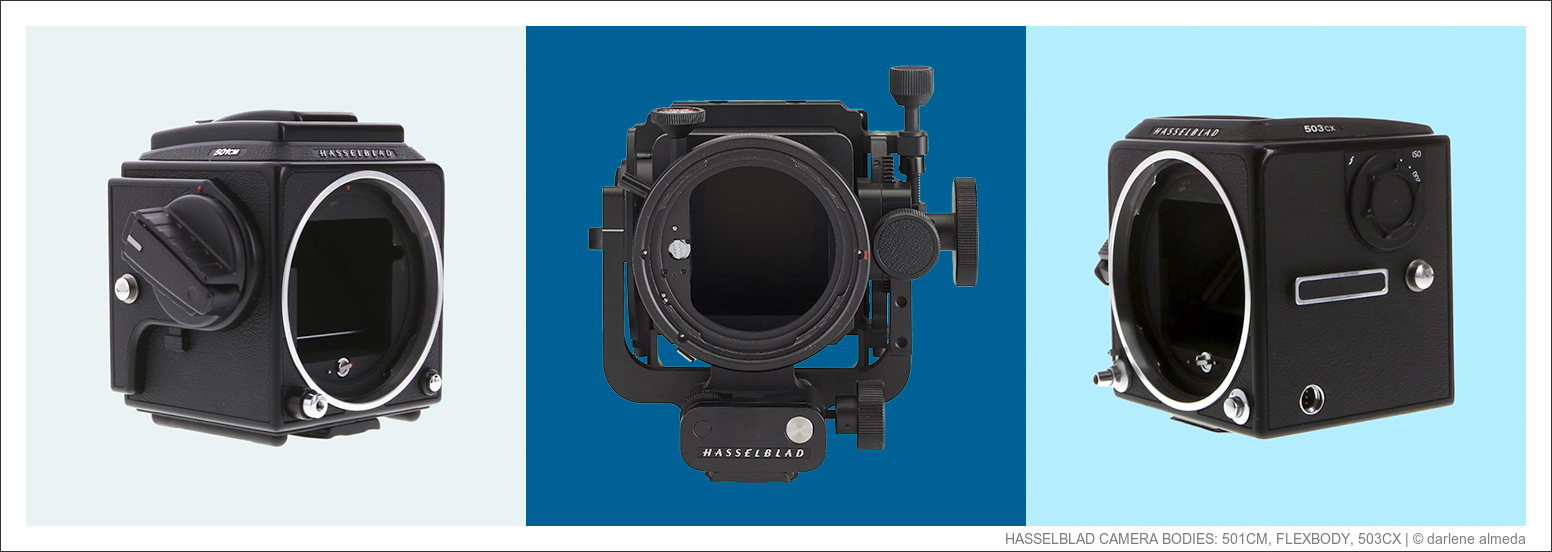
HASSELBLAD V BODIES
The 501C/M, FlexBody, and 503CX camera bodies are shown above, presented without lenses, film magazines, or digital backs. This represents the starting point for configuring a Hasselblad system with specific components. In my workflow, I use the 501C/M primarily with film magazines, the 503CX with a digital back, and the FlexBody with either.
503CX
The 503CX is my digital and film travel camera and features a custom mask on the focusing screen that matches the sensor size of my digital back. Manufactured from 1988 to 1994, it is available in chrome or black and was designed with an automatic dedicated flash system, a much brighter Acute-Matte focusing screen, and a new Palpas coating on the interior surfaces to reduce flare. You can view the 503CX user manual here.
I acquired the 503CX because I wanted the latest body in the 500 series, which includes the Time Exposure Lock (TEL). The TEL has two settings: O (disengaged) and T (engaged). The TEL is used for time exposures set at Bulb (B) when a locked exposure is required. Set the lens to B, depress the shutter, and secure it with the catch set to T. This is especially useful when working with Live View on a digital back, instead of using a mechanical locking release cable to hold the shutter open.
The winding crank can only be advanced once the lock is reset to O, and a cable release cannot be used while the TEL is engaged. If you enjoy engaging the electronic shutter with your digital back and a Hasselblad V body, as I do, you will appreciate the TEL option.
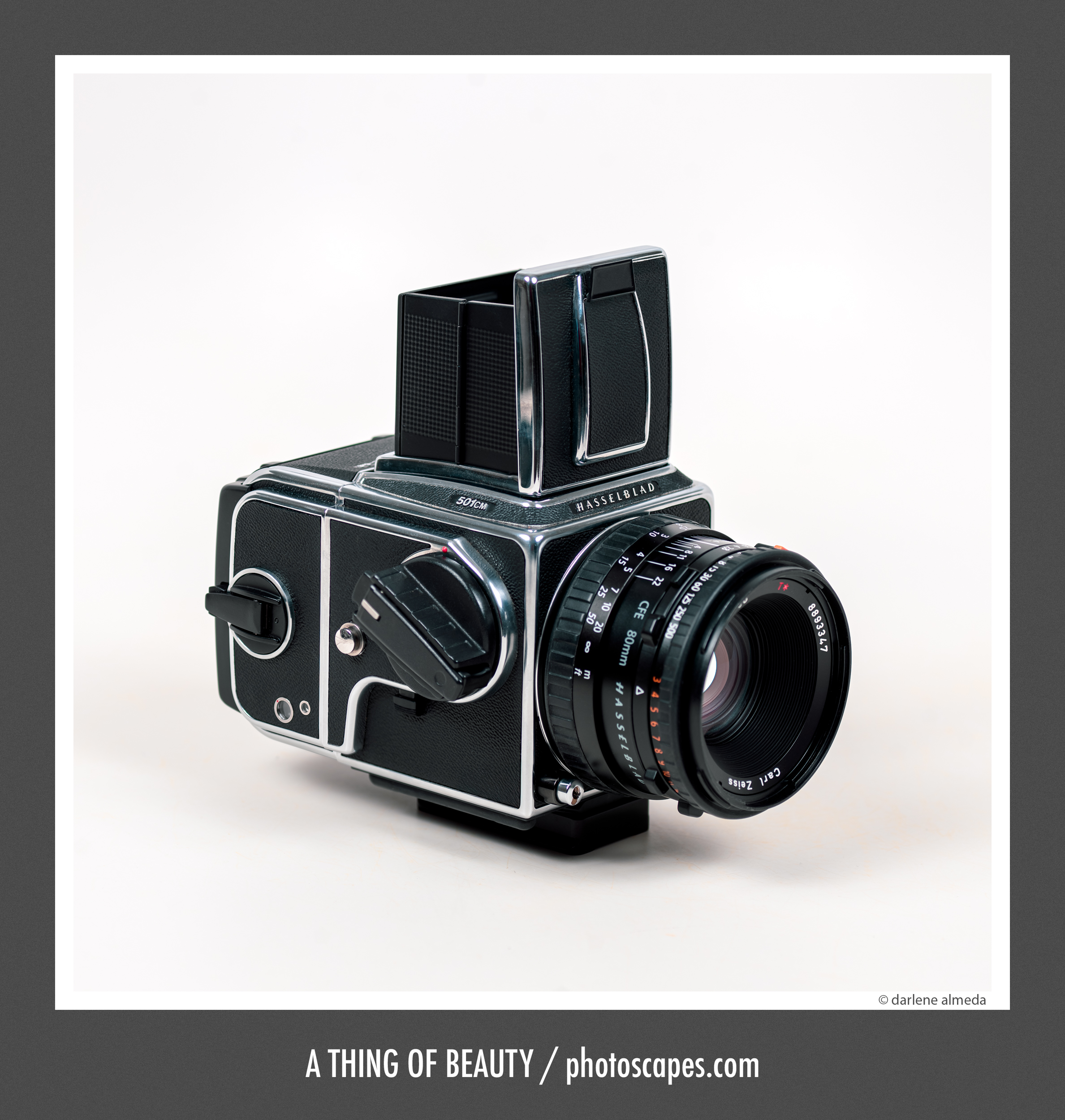
HASSELBLAD 501C/M + CFE 80/2.8
501C/M
The 501C/M is one of the last bodies in Hasselblad’s 500 series. Production began in 1997 and ended in 2005. The Gliding Mirror System (GMS) ensures there is no vignetting in the finder image with focal lengths over 100 mm. The 501CM was initially available as either a kit or a standalone body in chrome or black. You can view the 501C/M user manual here.
I use my 501C/M exclusively as a film camera. It features a bright Acute-Matte D Grid focusing screen (#42217). I prefer grid lines on most focusing screens and use them as a design aid for composition. When viewing through my preferred finder, the PME51—with its built-in exposure meter and upright view—everything I see in the finder is included in the final composition.
FLEXBODY
The FlexBody is a small-view camera that performs similarly to a 4×5, but in a 6 cm × 6 cm package. Its ±30° rear tilt allows control of the plane of focus without excessive stopping down. Its ±15 mm of shift helps control perspective, and its 22 mm bellows extension enables macro work with the CF/i 120 mm Macro lens without the use of extension tubes.
Hasselblad produced the FlexBody from 1995 to 2003. It accepts all CF lenses, Hasselblad film magazines, viewfinders, and V-style digital backs. When additional extension is not needed, the bellows can be kept retracted, and the FlexBody used like any other 500 series camera body. The FlexBody was produced in two variations, though formal documentation is difficult to locate; one version includes a bubble level on the shift control knob, while the other does not. A FlexBody manual is available here. It is an excellent choice for use with a digital back. (More information is provided in the Digital section.)
A recommended video by Carl Bozza demonstrating the FlexBody’s movements.
NOTE: FLEXBODY ≠ DIGITAL TECH CAMERA
While it is possible to work around this limitation by using a high-megapixel back and using the square crop in Live View, this is not an approach I personally recommend for photographers seeking the flexibility and precision of a true digital technical camera system. This is why I use ALPA technical cameras alongside my Hasseblad gear.
FILM IMAGES CAPTURED WITH 500 V SERIES CAMERAS