“BABY” COLOR 6×9 + 1957 BROCHURE + MASTER TECHNIKA V
INTRO
Linhof is one of the world’s most respected camera manufacturers, renowned for exceptional craftsmanship, precise engineering, and uncompromising build quality. For decades, professional photographers, particularly those specializing in architecture, landscape, and studio photography, have relied on Linhof view cameras for their precision, versatility, and outstanding image quality.
My first Linhof was a 6×9 Baby Color, followed years later by a Linhof Master Technika 3000 when the opportunity arose to add one to my collection. Its modular design, close tolerances, and mechanical precision make it one of the finest cameras I have ever used. In my experience, Linhof products consistently meet or exceed expectations. In fact, I often wish my Ebony RSW had a Linhof back so it could take advantage of Linhof accessories. That is how highly I regard their system.
Below is a record of the Linhof cameras and accessories I have used.
MY LINHOF GEAR EXPERIENCE
LINHOF cameras & related equipment used with these cameras.
LITERATURE & LINKS
LINHOF:website
LINHOF:historical
LINHOF MANUAL:Master Technika 2000
LINHOF MANUAL:Master Technika 3000 Amendments to 2000
DOWNLOAD FILES:Linhof DOF Charts by Format
LINHOF HISTORICAL
THE LARGE FORMAT LENS EXPLORER
LINHOF “BABY” COLOR 6×9
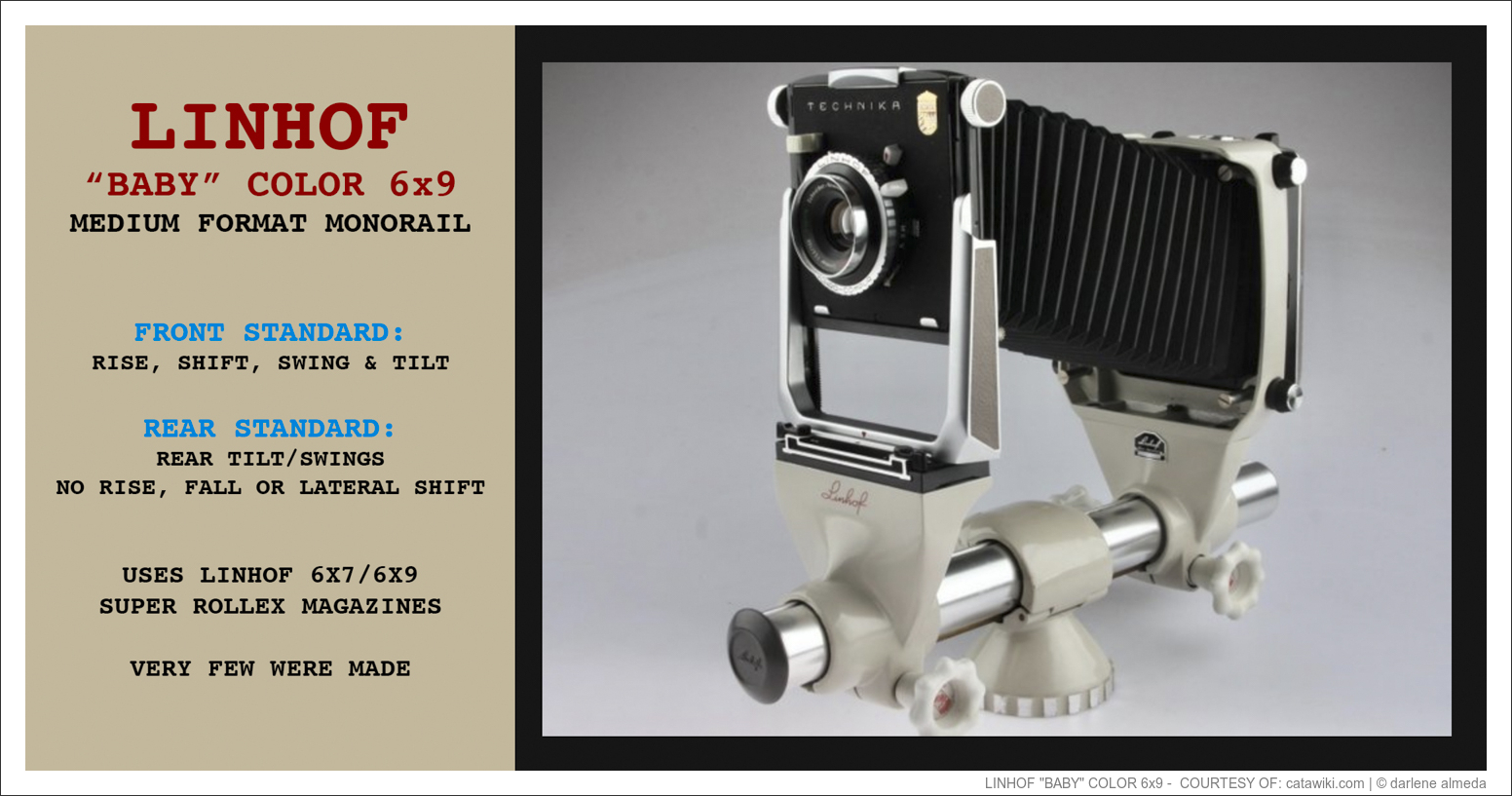
LINHOF “BABY” COLOR 6×9
The Linhof Baby Color 6×9 was my introduction to Linhof cameras. I purchased it through an auction house in Austria. By today’s standards, it is a minimalist monorail camera with limited rear movements, but that simplicity can actually be an advantage when using a digital back. Fewer rear movements reduce the possibility of introducing sensor angles that can compromise image quality, making the camera surprisingly well suited to digital capture.
According to the accompanying documentation, my Baby Color was built in 1964. I photographed with it in the studio for about two years before eventually selling it to a collector. Its exceptional condition made it more of a collectible than a working camera, and I felt it deserved to be preserved. Even so, I have thought about that little camera many times over the years and hope its owner has enjoyed it as much as I did.
HIBISCUS: A LINHOF BABY COLOR 6×9 IMAGE

The Baby Color was a charming little monorail in its day, capable of producing truly beautiful images. I always found it enjoyable to use, despite its limitations. The photograph above remains one of my favorite images made with that camera.
Recently, while searching through my gear closet, I came across the original Linhof 6×9 cut film holder that came with it. Seeing it again brought a smile. During the time I owned the camera, I photographed exclusively with a Linhof Super Rollex 6×9 roll film magazine loaded with transparency film, so I cannot really comment on the cut film holder’s performance. I am simply grateful to have had the opportunity to own and photograph with such a historically significant and beautifully crafted little camera. They simply do not make them like this anymore.
LINHOF MASTER TECHNIKA 3000

MY MASTER TECHNIKA 3000 RESTORED
When the time came to replace my well worn studio 4×5 camera, whose plastic components had finally succumbed to years of professional use, I chose a Linhof Master Technika 3000. I found a used MT 3000 at an excellent price, and it quickly proved to be one of the most versatile cameras I have ever owned. Compact, quick to set up, and wonderfully intuitive to use, it soon became my favorite in studio 4×5. Its generous bellows extension comfortably accommodates my preferred lenses from 150mm to 300mm, along with the occasional 120mm macro, making it ideally suited for the product and still life photography that occupies much of my time.
Where the MT 3000 is less at home, at least for me, is with lenses wider than 90mm. I have successfully used a Rodenstock 65mm on it, but it requires more setup and adjustment than I enjoy when working in the landscape. The reason is the camera’s compact design. To use the 65mm, the bed must be dropped and the top flap opened, and even then I have to be careful not to let any part of the camera intrude into the image. With enough patience it works, but I would rather spend my time making photographs than fiddling with camera adjustments in the field. That is precisely why my Ebony RSW45 and Cambo Wide 650 remain my preferred landscape cameras.
No camera is perfect, however, and the MT 3000 has a couple of limitations worth mentioning.
The first is its use with lenses wider than 90mm. As I mentioned above, lenses such as a 65mm can certainly be used, but they require enough setup and compromise that I prefer cameras designed specifically for wide angle work.
The second limitation involves the LomoGraflok 4×5 Instant Back. Although the back mounts perfectly to the Linhof’s Graflok, the compact rear body of the MT 3000 prevents the exposed Instax film from exiting the back for development. My workaround is simple. After making the exposure, I remove the LomoGraflok back, press the film release button so the sheet can develop, set the film aside, and then remount the back for the next photograph. It works, but it interrupts the workflow enough that I now use my Sinar Norma whenever I want to shoot Instax film.
Neither of these issues is really a flaw in the camera. They are simply the result of Linhof engineering the Master Technika 3000 to be as compact as possible. That compactness is one of its greatest strengths, but it also means accessories never envisioned by Linhof’s engineers may occasionally require a creative workaround. Understanding the camera’s design priorities helps set realistic expectations.
For photographers interested in experimenting with unconventional accessories or specialized techniques, I recommend having access to a 4×5 monorail camera as well. Between the two camera types, there is very little that cannot be accomplished.
For the way I work, the MT 3000 offers exactly the versatility I need for product photography, still life, and close up work. It accommodates my preferred range of lenses beautifully, and every control operates with the smooth, confident precision that reminds you why Linhof has earned its reputation. Even after years of regular use, it remains one of the finest engineered cameras I have ever owned.
PURPLE WHITE HYDRANGEA: A LINHOF MT 3000 IMAGE

In 2020, my beloved MT 3000 took a hard fall from the tripod onto the studio’s tiled floor. My heart sank. I feared the worst, imagining an expensive repair or perhaps the end of a camera I had grown to love. Fortunately, although the impact caused operational damage, it was remarkably repairable. A few replacement parts, expert adjustments, and a repair bill of less than $500 returned it to full working order. The cosmetic damage, however, was considerable. It was a testament to Linhof’s engineering that the camera continued serving me faithfully, but I quietly promised myself that one day, when the bellows eventually needed replacing, I would have it completely restored.
That day came in 2026.
I entrusted the restoration to Austin at LaFlex in New York. The camera received a new bed, replacement controls where needed, and a magnificent set of ruby red bellows. When Austin sent me the photographs of the completed restoration, I felt as though I had been reunited with an old friend. Every scar from its accident had disappeared, as if the past had been gently rewritten.
I have a habit of naming the cameras that earn a permanent place in my collection. Their names are never chosen in advance. They reveal themselves over time as each camera develops its own personality through years of use.
My Master Technika is affectionately known as Dorothy.
She is named in honor of my mother, Dorothy Jean, whose favorite color was red. The ruby bellows are more than simply beautiful. They are a quiet tribute to her memory. Every time I unfold the camera, I cannot help but think of her.
The photographs above are the images Austin sent me after the restoration was complete. A tremendous amount of work went into bringing Dorothy back to life, and I plan to document the restoration in greater detail in a future article. For now, I simply wanted to introduce her.
After eight years of working together, I know exactly what Dorothy does well and where another camera is the better choice. That familiarity is one of the greatest compliments I can give any photographic tool. Rather than working around the camera, I simply work with it. Few cameras have earned my trust as completely as this one.
AFTERNOON AT THE MARSH: MT 3000 + SHEN HAO 6×17 BACK
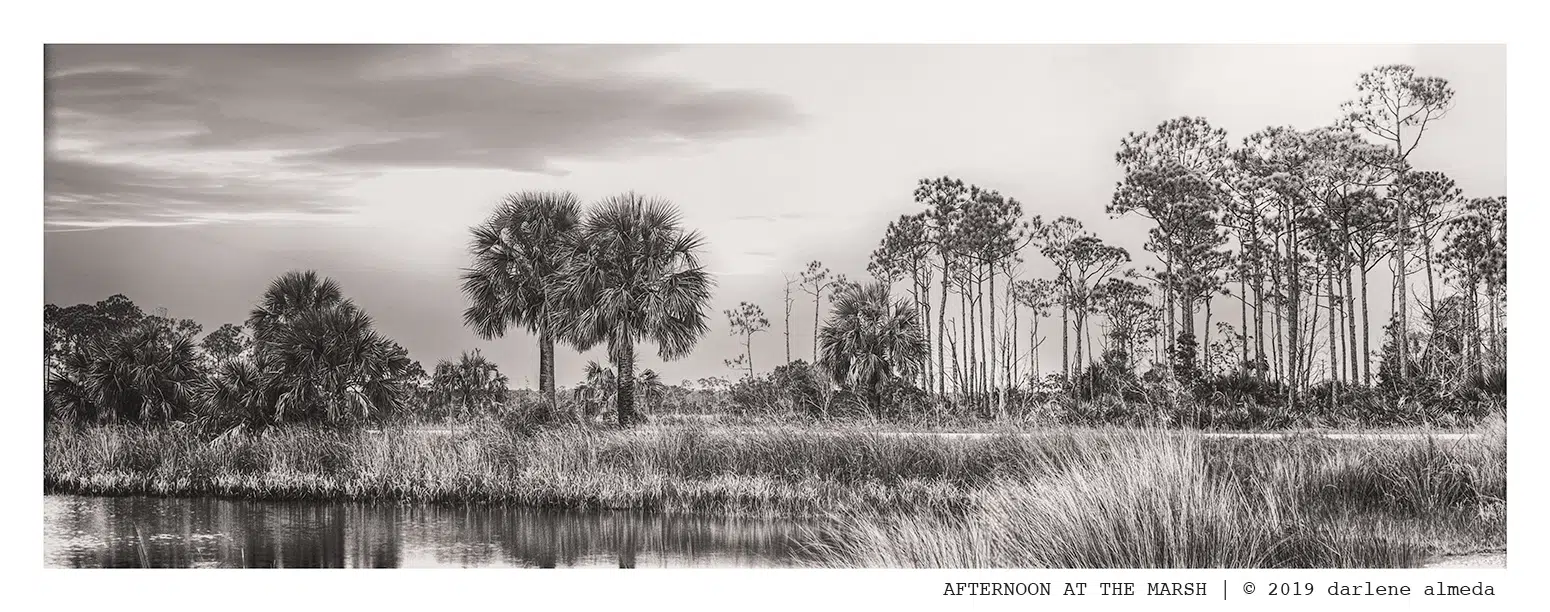
Like many large format photographers, I became curious about shooting 6×17 panoramas with a 4×5 camera. The idea is very appealing: one camera, one set of lenses, and the option to switch between formats simply by changing the film back. What a dream come true!
It turned out to be a little more complicated than that.
A 6×17 back cannot simply be mounted onto a standard 4×5 camera and expected to focus correctly. The Shen-Hao 6×17 back incorporates a spacer behind the camera, moving the film plane rearward so the supplied ground glass focuses accurately. In effect, your 4×5 camera behaves more like a 5×7 camera, and that immediately brings lens coverage into the equation.
Whether the system works depends largely on your lenses. When you assembled your 4×5 outfit, were you intentionally selecting lenses with enough image circle to cover 5×7, or were you choosing them solely for 4×5? Before purchasing any 6×17 back, I recommend checking the manufacturer’s specifications to determine which focal lengths are supported, then comparing those requirements with the image circles of your own lenses.
The Master Technika 3000 handled the Shen-Hao back without complaint. The challenge wasn’t the camera, it was the back itself. By the time the spacer, focusing screen, and film holder were assembled, the package had become considerably bulkier than I enjoyed carrying into the field. Setting it up felt more like assembling equipment than making photographs.
Eventually, I decided the compromises outweighed the advantages and sold the Shen-Hao back.
Today, if I want a panoramic composition, I’m perfectly happy cropping a 4×5 negative or using one of my Cambo Wides I have setup as 6×12 cameras. After all, I’m photographing for my own enjoyment, not trying to satisfy a specification sheet.
When I know the day’s work is going to be exclusively 6×17, I simply reach for the Fotoman 6×17 that I re-acquired in 2024. It is everything I want in a panoramic camera: simple, purpose-built, and refreshingly uncomplicated. Mine is fitted primarily with a Nikkor SW 90mm f/4.5, the lens perspective that first made me fall in love with the format years ago. More recently, I added a Schneider 150mm f/5.6 mounted in the proper Fotoman cone, originally for a studio project… although experience has taught me that cameras often lead us in directions we never expected.
Looking back, the experiment was worthwhile. It answered a question I had long wondered about, and that’s reason enough to try something new. Sometimes the greatest value of an experiment isn’t discovering a better way to work, it’s confirming that the way you’re already working suits you just fine.
IMAGE: BEHIND THE SCENE: MARSH FLOWERS

LINHOF TECHNO ROLLEX 6×12 MAGAZINE
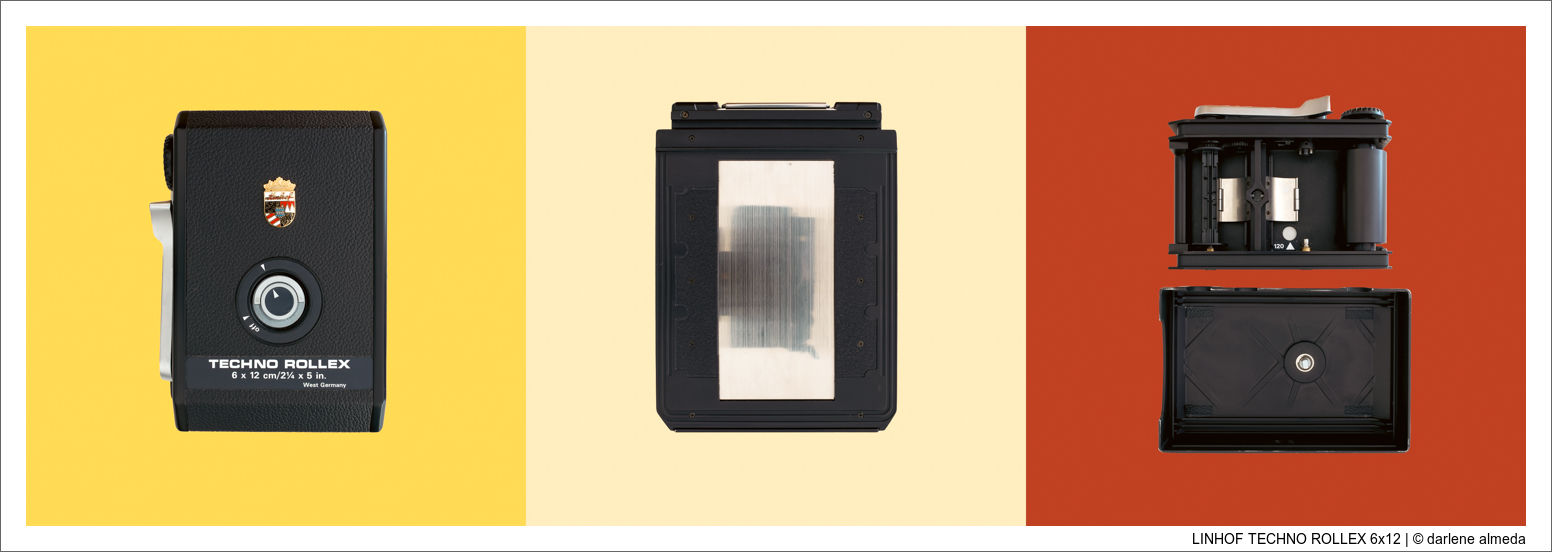
LINHOF TECHNO ROLLEX 6×12 FILM MAGAZINE
When I have not used this magazine for 6 or 8 weeks due to the summer heat or biting bugs in the marsh landscape, I love to shoot in; I practice loading it with a roll of film I have numbered with a marker seen within each frame to make sure I remember how to load it correctly (practice for perfection). Overall I enjoy this 6×12 back but would be happy shooting a Horseman if I did not have the Techno.
UPDATE: TECHNO 6x12
UPDATE: SHEN HAO DA YI 6x12
LINHOF BELLOWS FOCUSING VIEWER
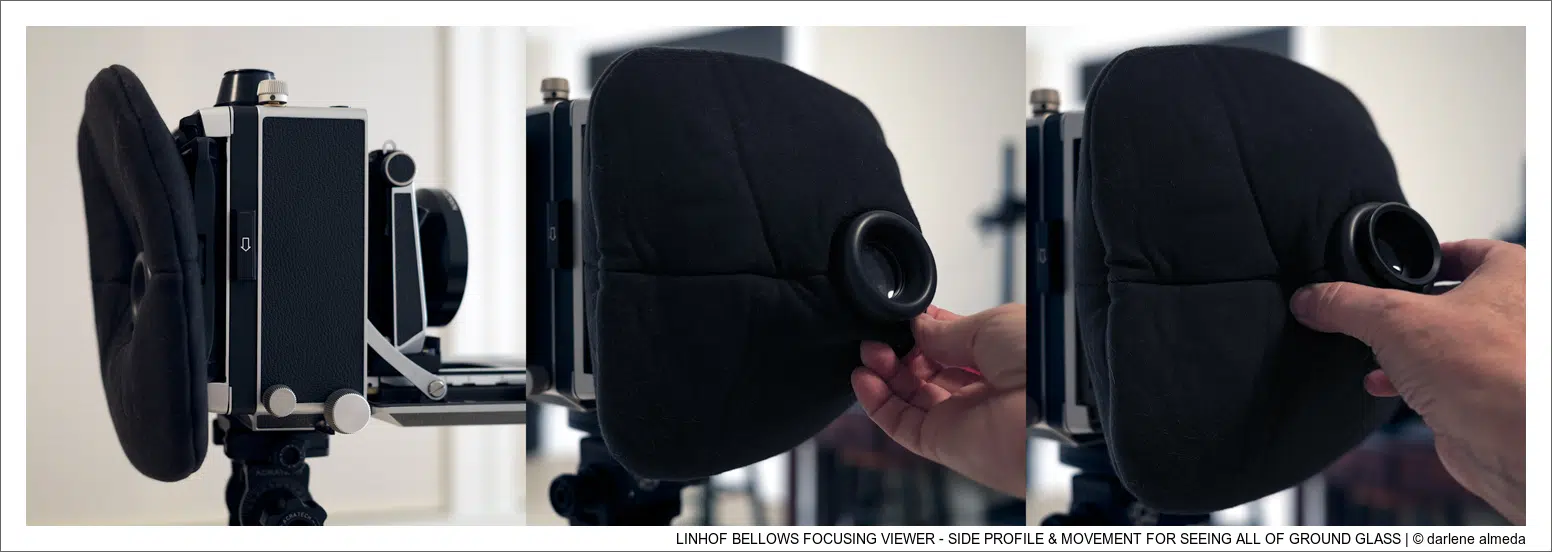
LINHOF BELLOWS FOCUSING VIEWER – SIDE & SEEING ALL OF GROUND GLASS
Captured with my Fujifilm X100V, the first image reveals this viewer’s sleek, low profile. It’s as flat as a pancake, effortlessly fitting into the front pocket of my backpack. The viewer extends slightly, allowing you to scan from one corner of the frame to the other. Its negligible weight mostly comes from the robust metal plate that attaches to the ground glass and the focusing loupes it features.
For a comprehensive look and precise composition, there’s the built-in 2x loupe. For more critical focusing, the included 2x magnifying loupe screws into the first loupe, effectively making it a 4x loupe. In the center image, you’ll notice the viewer without its magnifying loupe, giving a clear view of the entire ground glass. The magnifying loupe is then added to the image on the right for fine-tuned focusing.
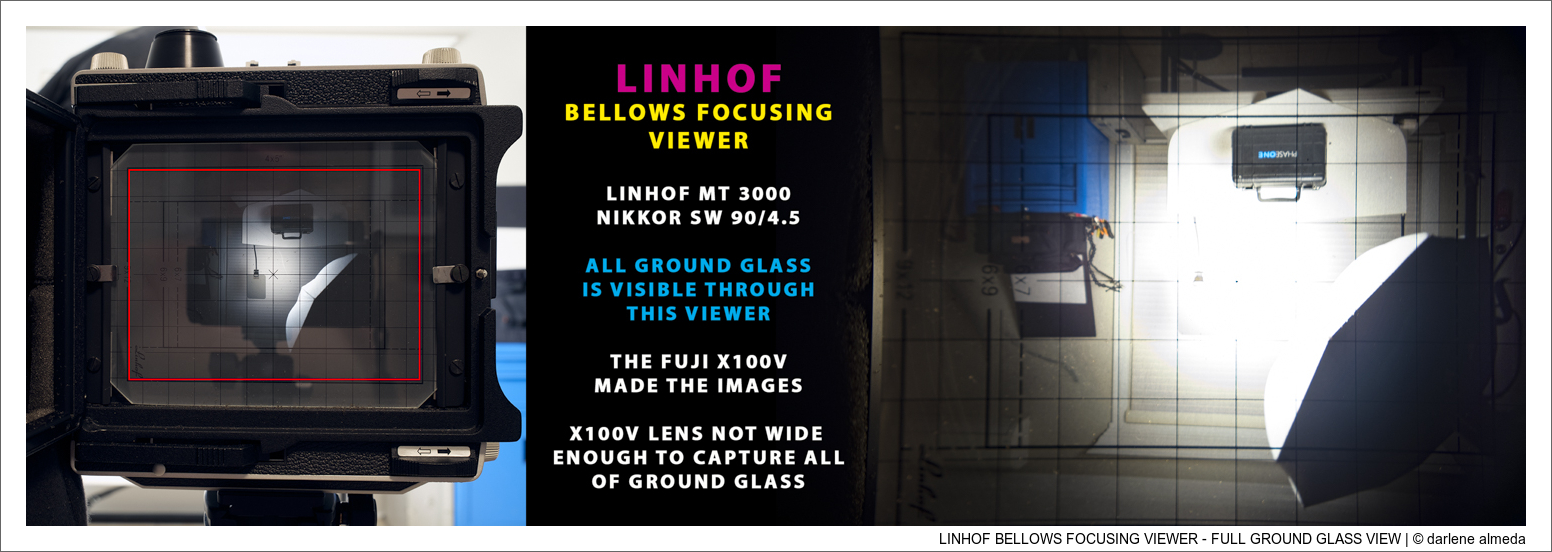
LINHOF BELLOWS FOCUSING VIEWER – FULL GROUND GLASS VIEW
The image on the right, taken through the viewer without the magnifying loupe, also fails to accurately portray what it is meant to represent.
I realized how inadequate these images were only after I had left the studio and packed away my gear. The X100V’s fixed lens cannot capture the whole scene of the ground glass when shot through this bellows focusing viewer.
You’ll have to take my word for it: to see the entire ground glass, the magnifying loupe needs to be removed. Those familiar with modern Linhof 4×5 Technika products know that their viewfinders are designed to cover the whole ground glass.
The top-left corner of the first image also shows where I usually place the additional 2x magnifying loupe when I need a complete view of the ground glass.
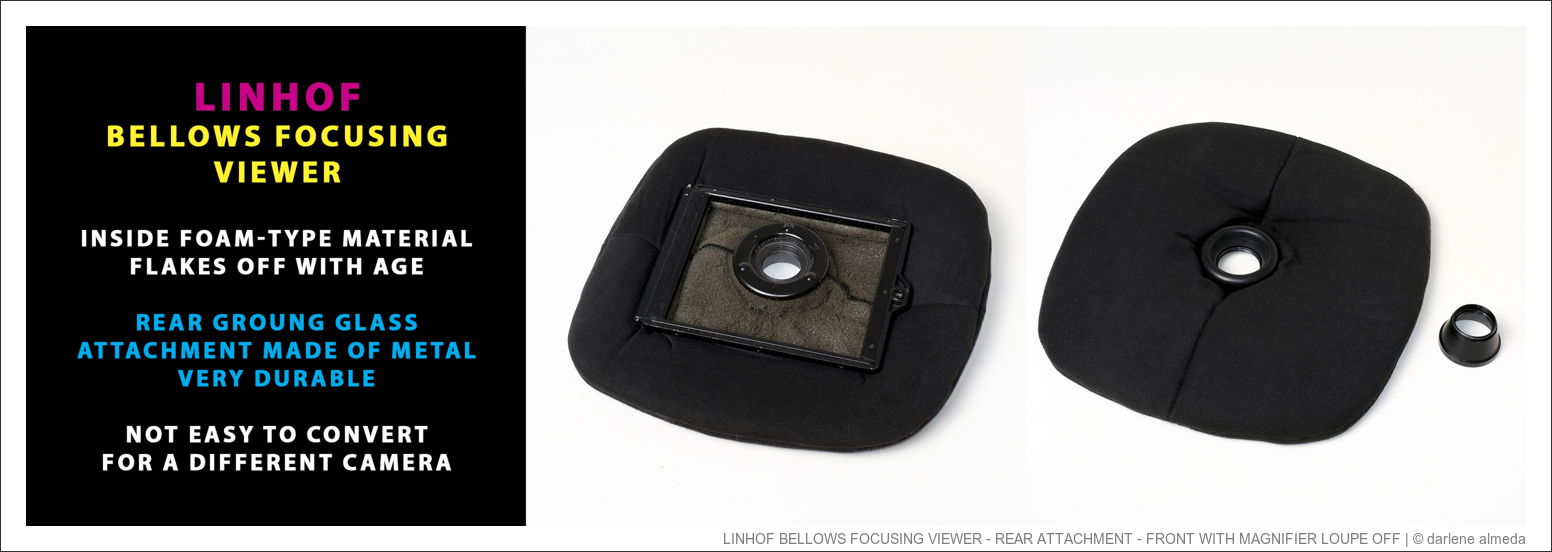
LINHOF BELLOWS FOCUSING VIEWER – REAR ATTACHMENT – FRONT MAGNIFIER LOUPE OFF
Only if I can secure it for at least half the list price, and if the material is more durable and resistant to wear over time. I’m so fond of this viewer that I’ve contemplated adapting it for use with my Ebony RSW camera.
However, it doesn’t seem like an easy modification. The rear attachment plate is fastened with multiple screws to what appears to be another plate. Crafting and attaching a custom plate designed for the Ebony would be far from straightforward. If this modification is even feasible, whom should I contact for a price quote? S.K. Grimes of Woonsocket, Rhode Island, that’s who.
240923 CUSTOMIZED BINOCULAR VIEWER
IMAGES MADE WITH LINHOF CAMERAS