
What an Optical Snoot Is — and Why Cookies Matter
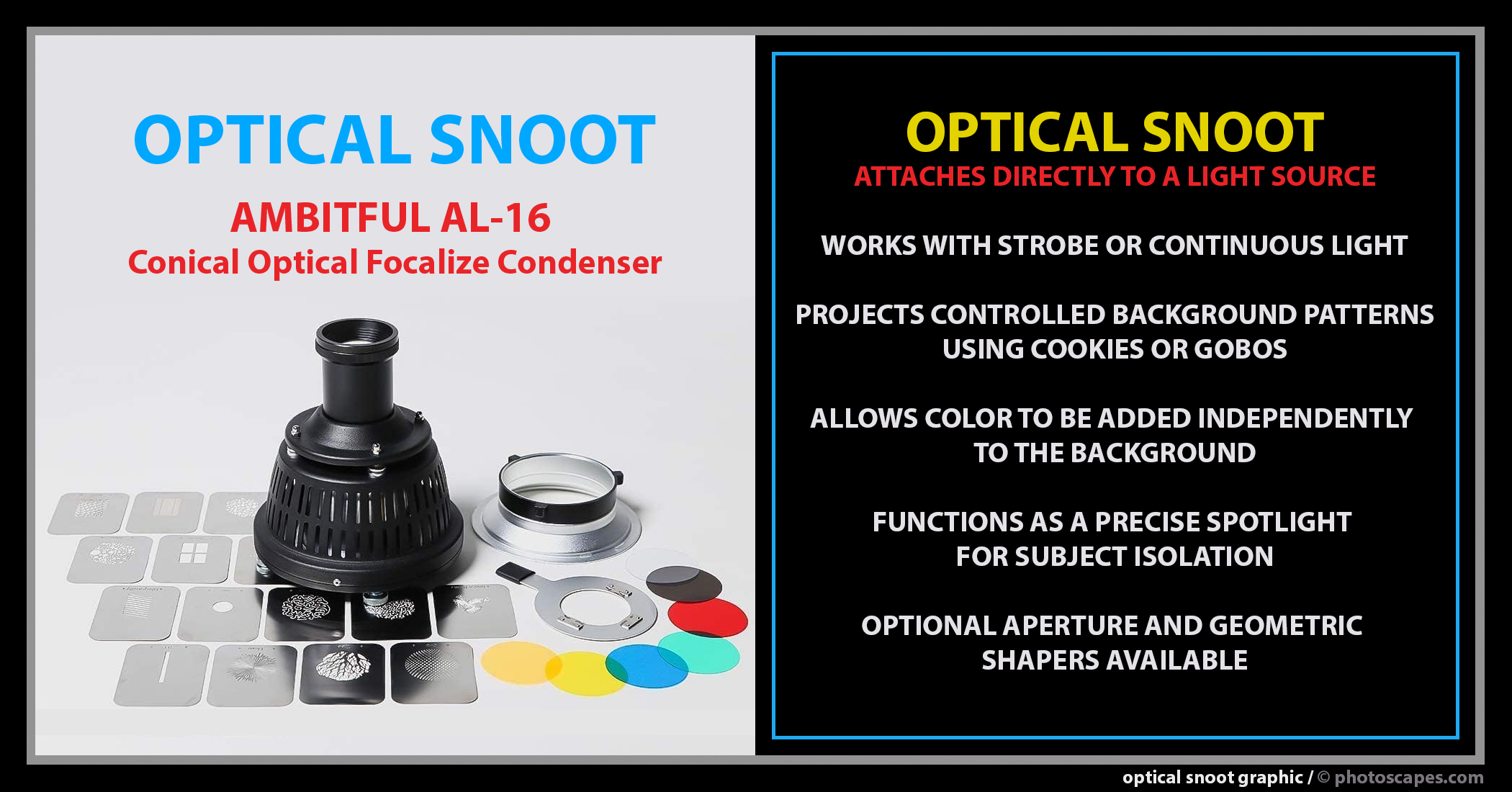
I call it an optical snoot, but it goes by many names and even more personality types: projection attachment, spot projector, or — my personal favorite — conical optical focalize condenser, which sounds like something you’d need a permit to operate.
Despite the impressive titles, what it does is refreshingly simple and very useful from a design standpoint. An optical snoot can function as a clean, controlled spotlight, or it can project color or a stenciled pattern onto a background. That stencil is often called a cookie (short for cucoloris) or a gobo (“goes before optics,” because photographers love practical names).
Since I tend to live somewhere in the middle — practical but curious — I call it an optical snoot. You’re welcome to call it whatever makes sense to you.
The unit I’m using is the Ambitful AL-16, which comes with a 50mm lens and a 58mm filter thread. I’ve included a manufacturer image that shows most of what came with mine, though apparently yellow filters were not invited to the party. The unit is designed to fit Bowens-mount lights, and since my lights are Profoto, I needed a separate adapter to make everything play nicely together.
This is not an expensive unit — and that’s intentional. The original Profoto version is no longer made and now lives in the land of “collector pricing.” I wanted one, but my budget very firmly said, absolutely not. So I went the affordable route.
This unit has limitations, and I’m not suggesting anyone rush out to buy one. What I am saying is this: the concepts you’ll see here aren’t about brand or price. They’re about what’s possible when you start shaping light — whether your tools are improvised, borrowed, or thoughtfully chosen.
How to Use the Unit I Have
A cookie is a thin, flat piece of metal shaped a bit like a card, with a design cut out of it. That’s why I often think of them as stencils. They’re made of metal for a very practical reason: they sit between the light source and the optics, and things can get hot. Paper cookies are a short-lived experiment. Metal cookies live to see another shoot.
The optical snoot I’m using works with either a continuous light source or a strobe. At the front of the unit is a lens that can be focused forward or backward, allowing you to create designs that are razor sharp or softly out of focus, depending on your intent. Crisp patterns feel graphic and deliberate; blurred shapes feel atmospheric and suggestive. Both are useful. Neither is “wrong.”
The front of the lens also accepts colored plastic disks, which drop into a filter ring if you want to introduce color. If you do go that route, I recommend using a neutral gray background. Gray behaves nicely — it doesn’t argue, and it allows color to saturate cleanly without turning muddy or unpredictable.
Below are a series of images I made specifically for this article using this unit. They’re not meant as recipes to follow, but as examples of what happens when you start paying attention to where light lands, how it breaks up, and how a little restraint goes a long way.
The exact camera and lens, and visual perspective were used in all images.
Safety note: These get hot enough to remind you why cookies are metal, not paper — give everything time to cool before touching or swapping pieces.
Images Made with Ambient Light and an Optical Snoot
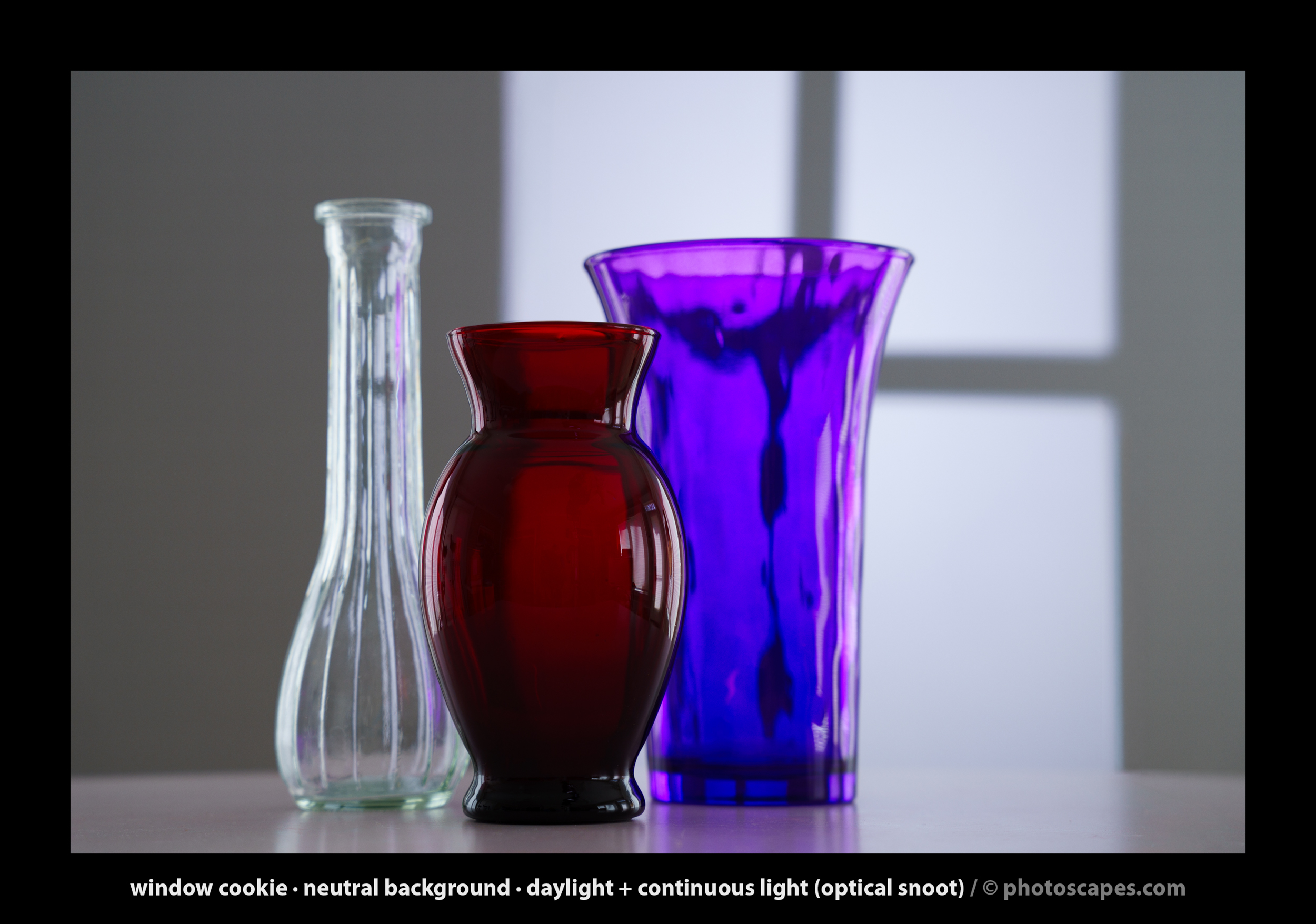
In the first image, the background pattern is created with a cookie placed in the optical snoot. The cookie produces a simple window-like shape, adding structure and a sense of place while keeping the light restrained and quiet. Nothing about the subject lighting is dramatic — the glass remains softly lit, and the background simply suggests an environment rather than describing one outright.
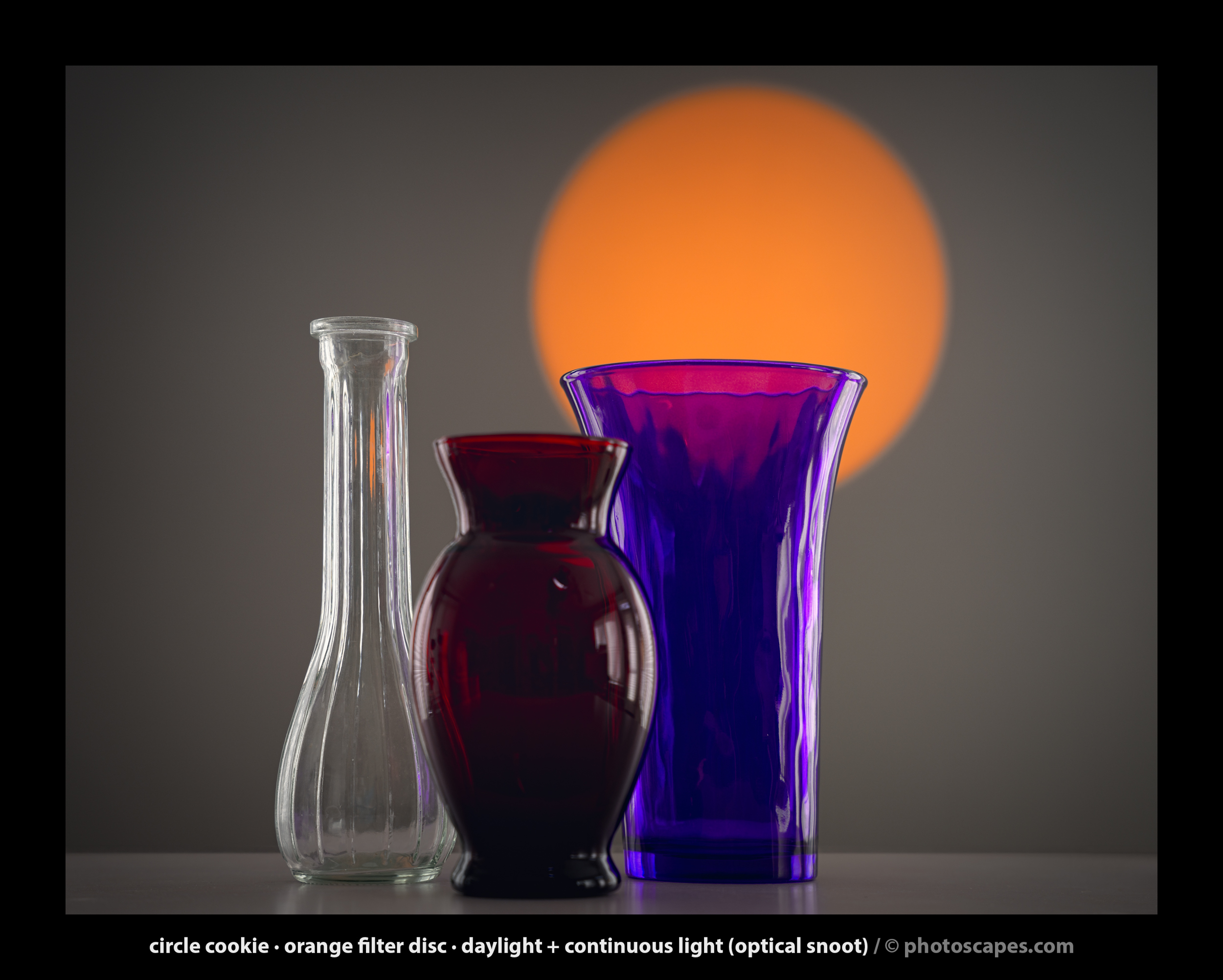
In the second image, the cookie is changed to a circle, and an orange filter disc is added to the optical snoot’s filter ring. The result is a clean, graphic shape with color — still simple, still controlled, but now more intentional. The glass objects haven’t moved. The subject lighting hasn’t changed. Only the design of the background light has been adjusted.
This small shift shows how cookies and filters can work together: the cookie defines the shape, the filter defines the mood. One decision introduces structure; the other introduces color. Neither overwhelms the scene, and both remain firmly in service of the subject.
This is where optical snoots shine — not by adding more light, but by giving you the ability to design the light you already have.
Before adding pattern or color, it’s worth seeing what the optical snoot does on its own.
Optical Snoot as Spotlight Only
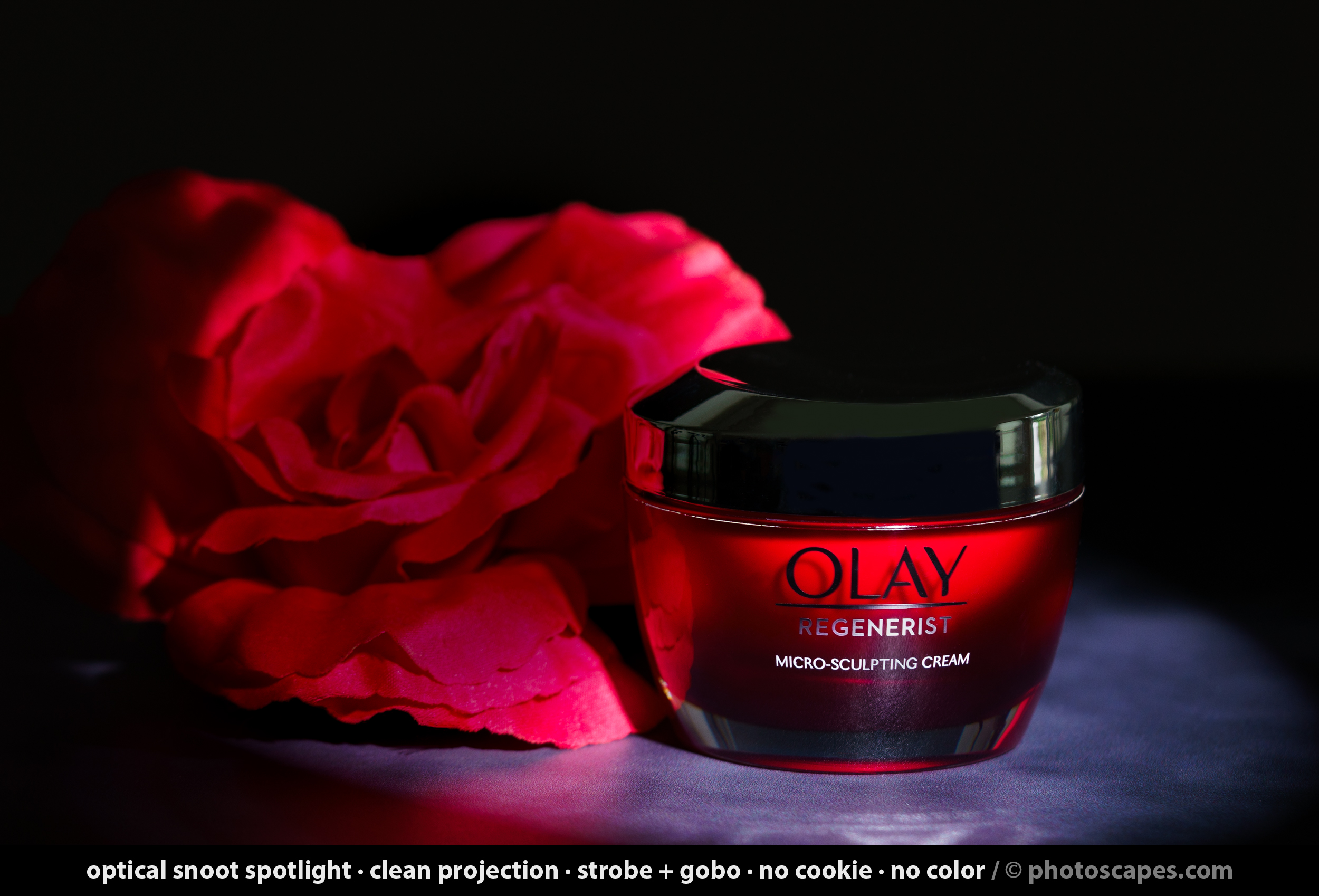
This is the optical snoot doing its simplest job — no decoration, no tricks, just controlled light.
Same Product, Different Decisions
The following two images were made with the same product, positioned in the same place, lit with the same primary light. Nothing about the subject changed.
Only the optical snoot changed.
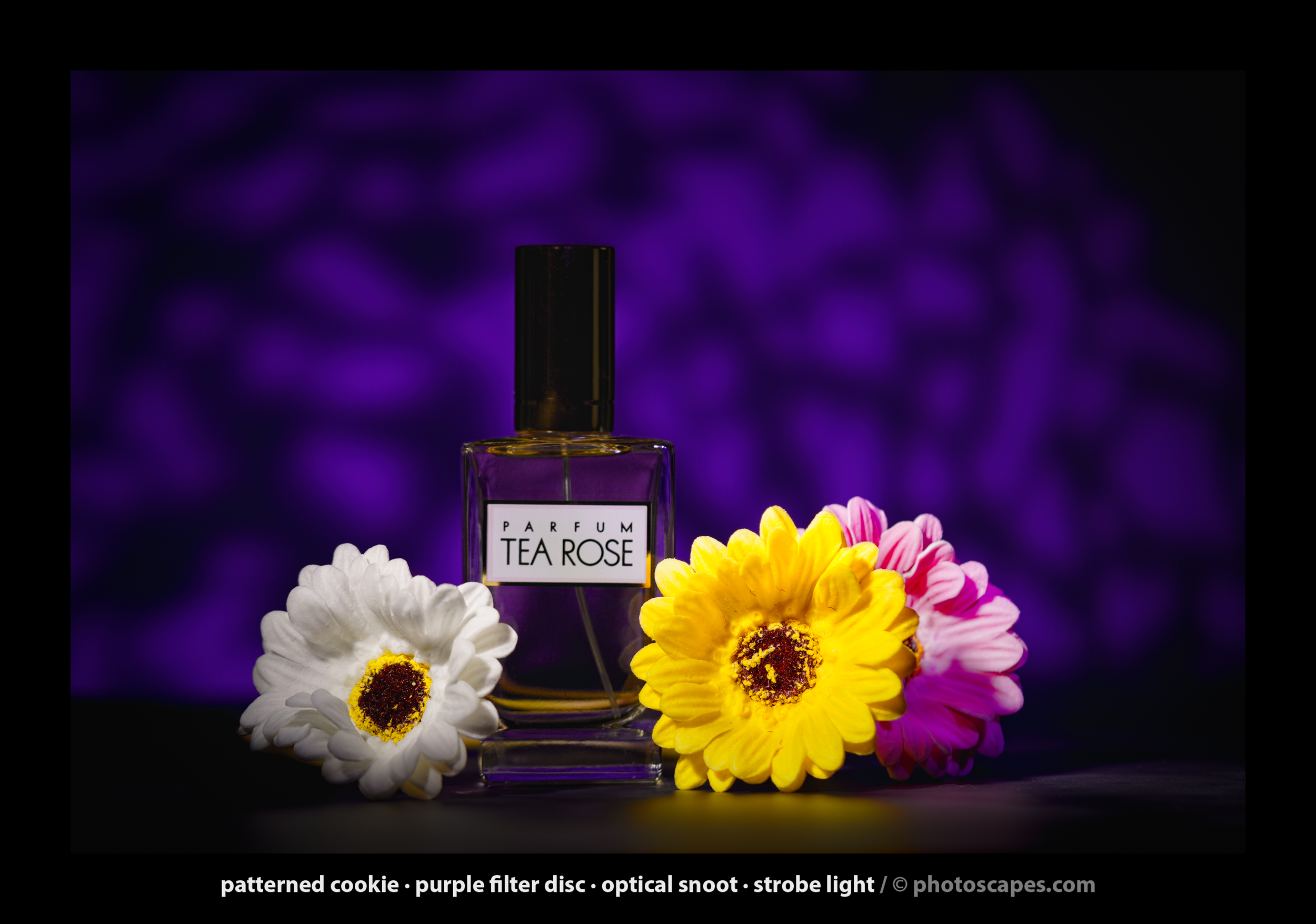
In the first image, a patterned cookie was placed in the optical snoot and paired with a colored disc to create a deep, saturated purple background. The projected pattern introduces texture and movement behind the bottle, adding atmosphere without touching the product itself. The subject remains clean and readable; the background carries the drama.
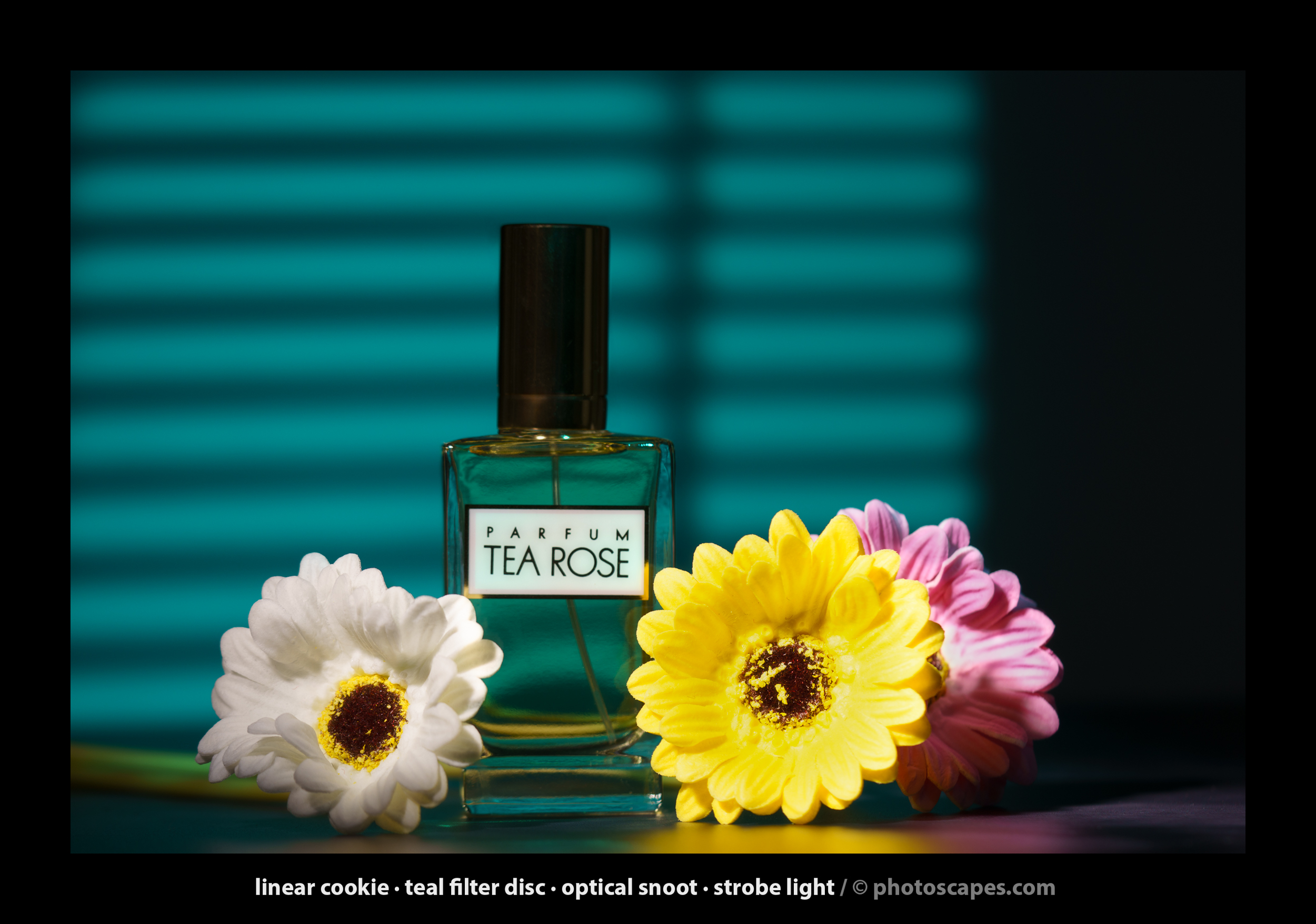
In the second image, a different cookie and a different colored disc were used. The horizontal bands and cooler tone shift the mood entirely. The bottle hasn’t moved. The flowers haven’t moved. The exposure hasn’t changed. But the environment feels different.
This is the quiet power of controlled projection.
You are not lighting the background randomly — you are designing it.
Cookies define the shape.
Filters define the mood.
The optical snoot delivers both with precision.
When you begin to think this way, backgrounds stop being “backdrops” and start becoming compositional elements.
What follows are behind-the-scenes images showing how these results were achieved — not as recipes to copy, but as reference points to help you understand placement, distance, and control.
For those that may want to see a different set of images made with this optical snoot, see my post titled: A Gobo, a Snoot and a Sandwich.
Behind the Scenes
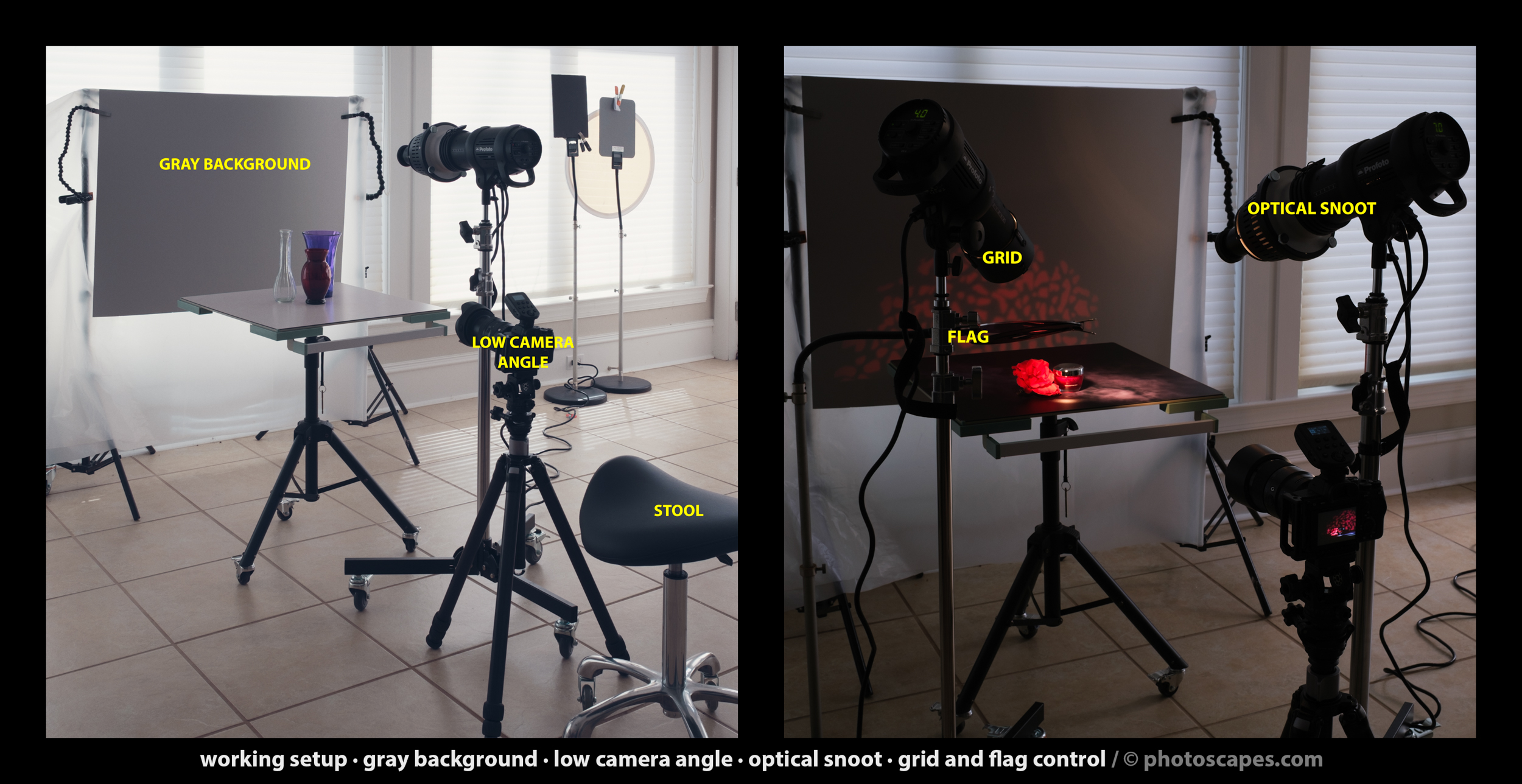
As a product photographer, I tend to shoot from a lower point of view, which is why I learned long ago to appreciate a good stool — preferably one with wheels. Being able to move in and out of a setup quickly lets me check angles, reflections, and alignment without constantly standing up and sitting down. Once I find the angle that works, I’ll place the tripod accordingly and continue working from the stool.
There have also been plenty of product shoots — especially catalog work — where I’ve happily whirled around the studio on that same stool, handholding the camera and firing the lights by feel. Wheels are not a luxury. They’re a lifestyle choice.
You’ll also notice the gray background. Gray is my go-to when I want maximum color saturation from gels, filters, or projected light. It stays neutral, doesn’t fight the color, and gives you clean, predictable results. In this case, a simple piece of gray mat board was all that was needed since the shooting table and products were small.
The first behind-the-scenes image shows the setup when ambient light was used along with the continuous modeling light of the strobe.
The second image captures one of the working “takes” while creating the product shot that ultimately became the clean spotlight image. A gobo was used to control spill from the gridded fill light, keeping light out of areas where it wasn’t invited.
Nothing complicated.
Just attention, placement, and a willingness to keep unwanted light in check.
What’s Up Next
Cookies and optical snoots are not about special effects — they’re about decisions. Each example in this lesson shows how small, intentional choices shape space, direct attention, and give meaning to a background without ever touching the subject itself. When you begin to think of light as something you design rather than simply add, backgrounds stop being an afterthought and start becoming part of the composition.
In the next lesson, we’ll look backward to move forward — exploring classic Hollywood-style lighting from the past, recreated with simple, modern tools. The goal isn’t nostalgia. It’s understanding how purposeful light has always done the heavy lifting.