Fujifilm X-E2 (590nm) | Anastasia Island, FL
Infrared photography invites us to see the world in a spectrum the eye cannot perceive. It reveals light beyond the visible, transforming familiar landscapes into dreamlike scenes where foliage glows, shadows deepen, and skies take on an otherworldly intensity. What feels ordinary in color often becomes quietly surreal in infrared.
While IR film has a long history in both scientific and creative use, digital conversions have opened the door for photographers to explore this invisible wavelength with far more ease and precision. A dedicated IR-converted camera removes the guesswork and allows you to compose and focus normally—yet the resulting images are anything but ordinary.
What Infrared Reveals
Infrared records the way subjects reflect or absorb IR light, which often differs dramatically from visible light.
Foliage turns bright and luminous.
Skies deepen toward near-black tones.
Water becomes mysterious and glassy.
Textures shift, shadows behave differently, and even human skin takes on a porcelain quality.
These tonal transformations are why IR photography often feels atmospheric, ethereal, or quietly surreal.
A Creative Toolset
There are many ways to approach infrared, from classic monochrome to false-color rendering. Conversion types—from 590nm to 850nm—each offer their own personality. At 590nm, color still plays a subtle role, allowing for gold-and-blue interpretations alongside crisp monochromes.
I currently work with a Fujifilm X-E2 converted to 590nm, a small, lightweight camera that travels easily and encourages experimentation. It allows me to explore both color and monochrome IR while retaining familiar Fujifilm handling and lenses.
Working in IR: Then and Now
Having started years ago with Kodak infrared film, I remember well the challenges of shooting IR with either film or an optical-viewfinder SLR. With film—and with converted DSLRs like my Sigma SD1 Merrill—you’re forced to work with a nearly opaque R72 filter. The only practical approach is to compose without the filter, attach it, and then pre-focus using the lens’s IR index mark (if the lens even has one), since infrared light focuses differently than visible light. It works, but it’s slow, fiddly, and far from precise.
A mirrorless IR-converted camera removes all of that friction. You compose and focus exactly as you would with a standard digital camera, yet you’re photographing in an entirely different wavelength. The process becomes fluid, intuitive, and genuinely enjoyable, letting the creative work stay at the forefront rather than the technical gymnastics.
For anyone curious about infrared, I highly recommend a mirrorless conversion. It opens the door to the infrared world without the hurdles that once made it difficult.
A 590nm Example: Marjorie’s Cupboard
Among the examples I share on this page is a photograph that demonstrates how a 590nm conversion can behave much like traditional black and white.
Marjorie’s Cupboard—made in author Marjorie Kinnan Rawlings’ historic Cross Creek kitchen—shows how naturally the X-E2 handles both infrared and monochrome. The absence of foliage or sky allows the tonal qualities to shine on their own, proving that 590nm isn’t limited to landscapes; it can deliver clean, elegant monochromes with remarkable subtlety.
That ability to move seamlessly between IR and B&W is one of the reasons I enjoy the 590nm conversion so much.
Why Infrared Matters as a Genre
Infrared photography stands apart from other genres because it challenges our assumptions about the world. It emphasizes:
- Atmosphere over accuracy
- Mood over documentation
- Interpretation over representation
Infrared is not just a technique—it’s a way of seeing differently. It aligns perfectly with fine-art practice, landscape exploration, and conceptual storytelling.
Whether used for quiet landscapes, architectural studies, or creative personal projects, infrared expands what a photograph can say.
Image Commentary
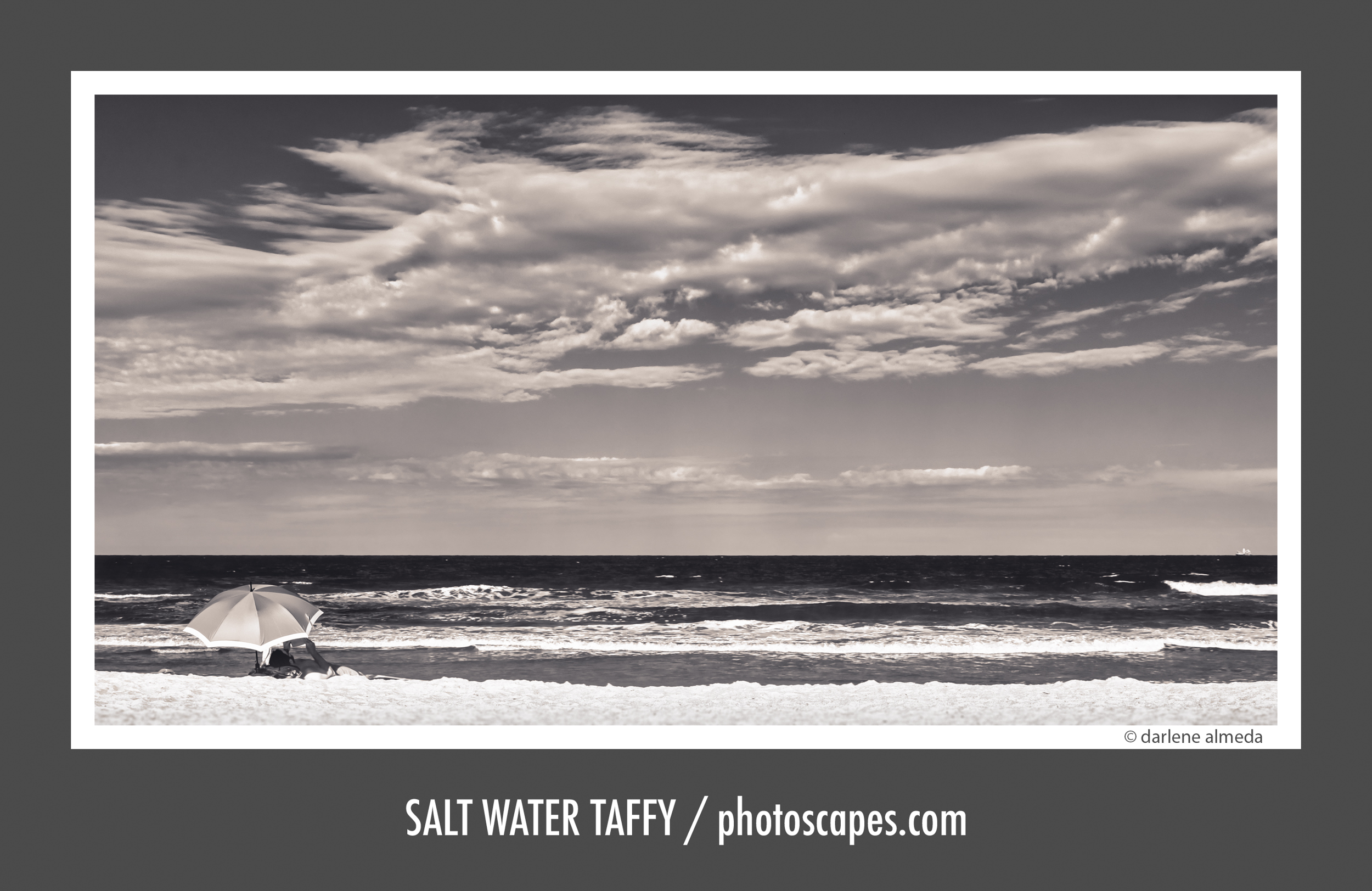
Salt Water Taffy — Anastasia Island, FL
This beach scene shows the soft, luminous quality of 590nm infrared at its most inviting. The umbrella becomes a white shell against a darkened sea, and the sky carries an intricate swirl of textures that would be less dramatic in visible light. IR gives this simple coastal moment a dreamlike stillness.
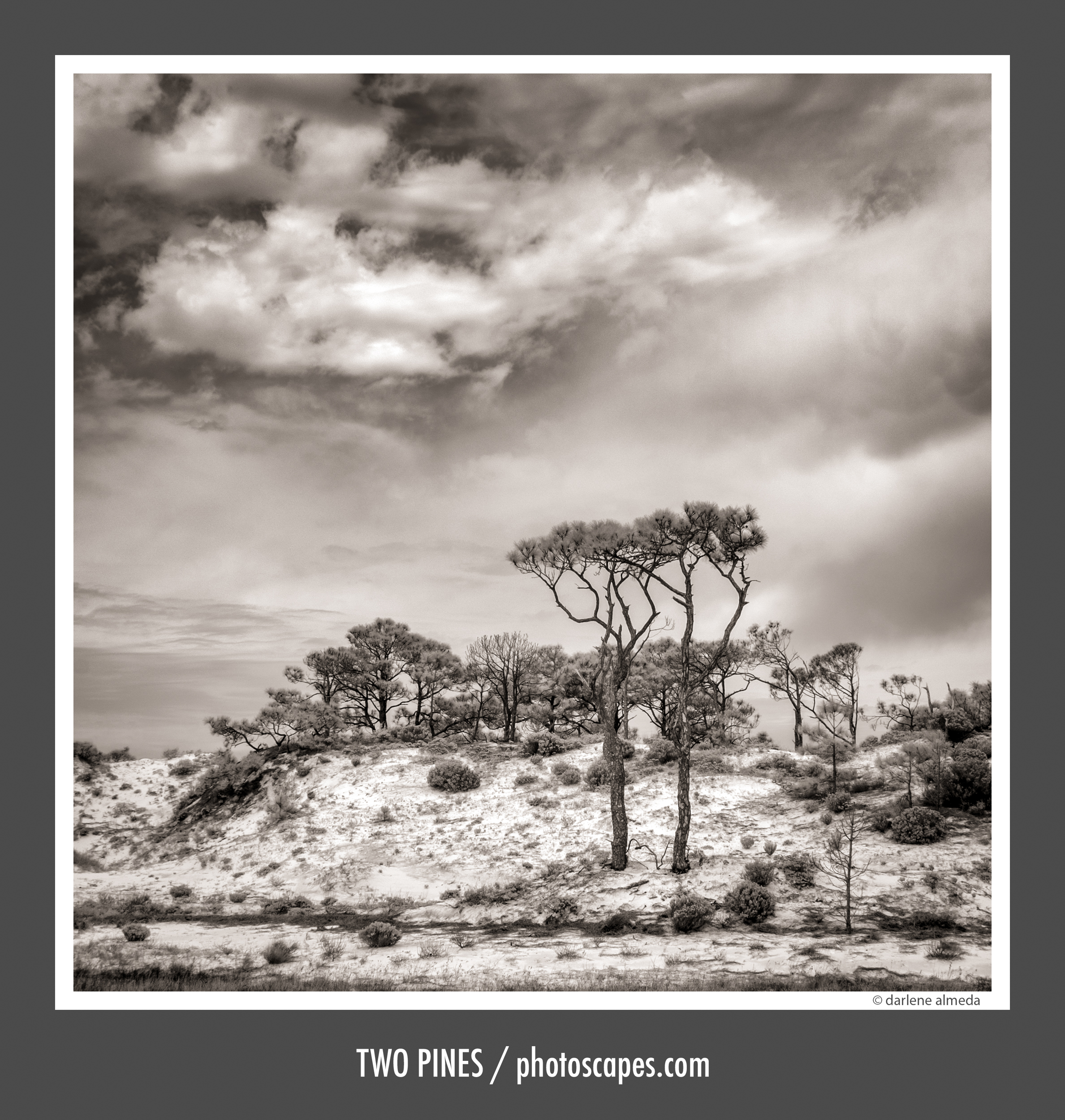
Two Pines
Infrared transforms this modest landscape into a stark, sculptural study of form. The foliage glows, the clouds build dramatic depth, and the trees become characters—etched silhouettes standing against a nearly blackened sky. It has that classic IR combination of quietness and tension.
Marjorie’s Cupboard
A reminder that infrared isn’t only for the outdoors. The absence of foliage allows the tones to settle into a beautifully soft monochrome. The jars and labels glow with gentle highlights, and the shadows fall in a way that feels reminiscent of early 20th-century film prints—fitting for Rawlings’ historic home.
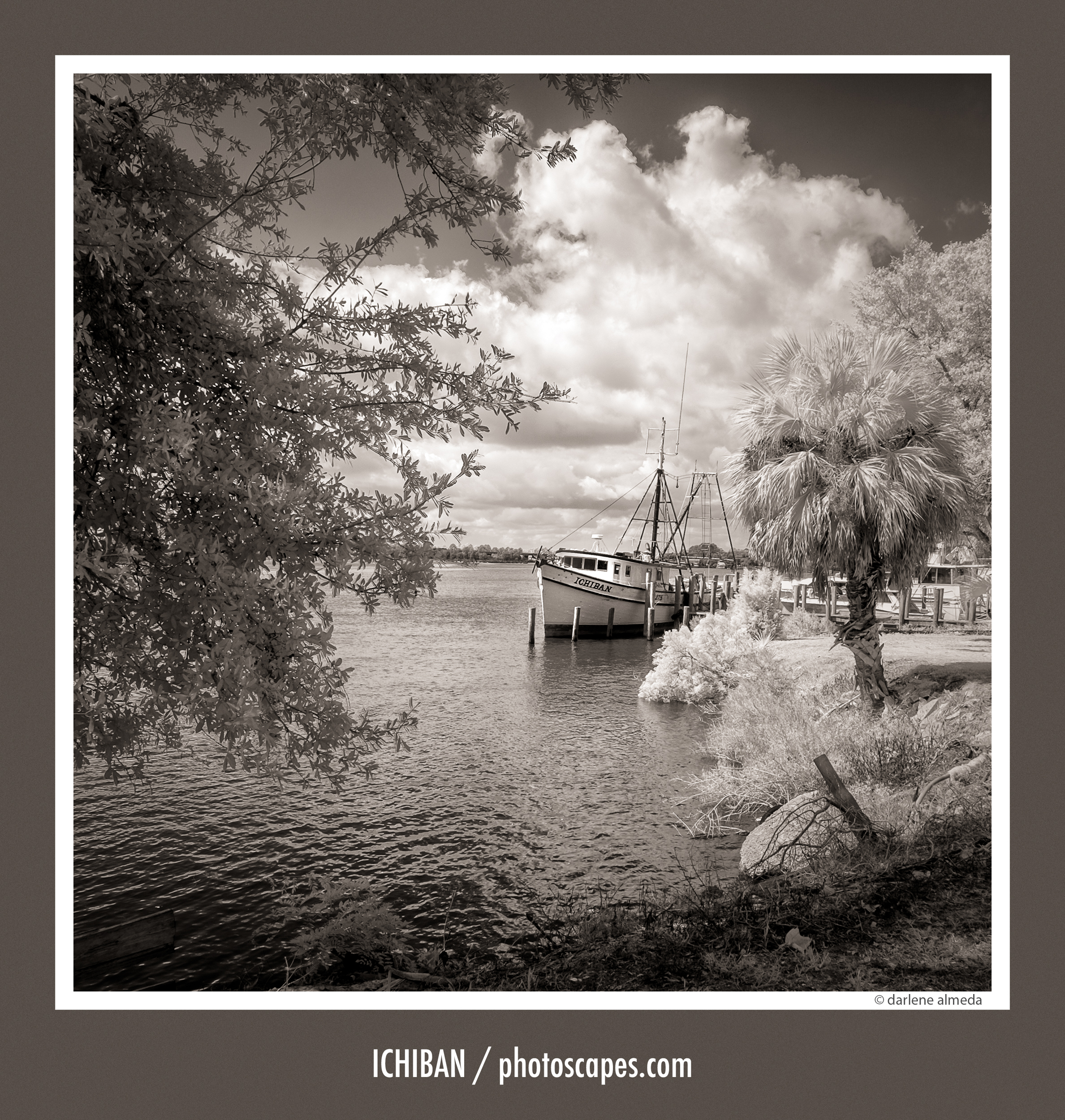
Ichiban
Here, IR brings a sense of stillness and gentle radiance to a waterside scene. The bright foliage frames the boat, while the deepened sky anchors the image with contrast. It feels timeless—almost like stepping into a quiet, humid afternoon that belongs to no particular decade.
words & images © darlene c. almeda / photoscapes.com