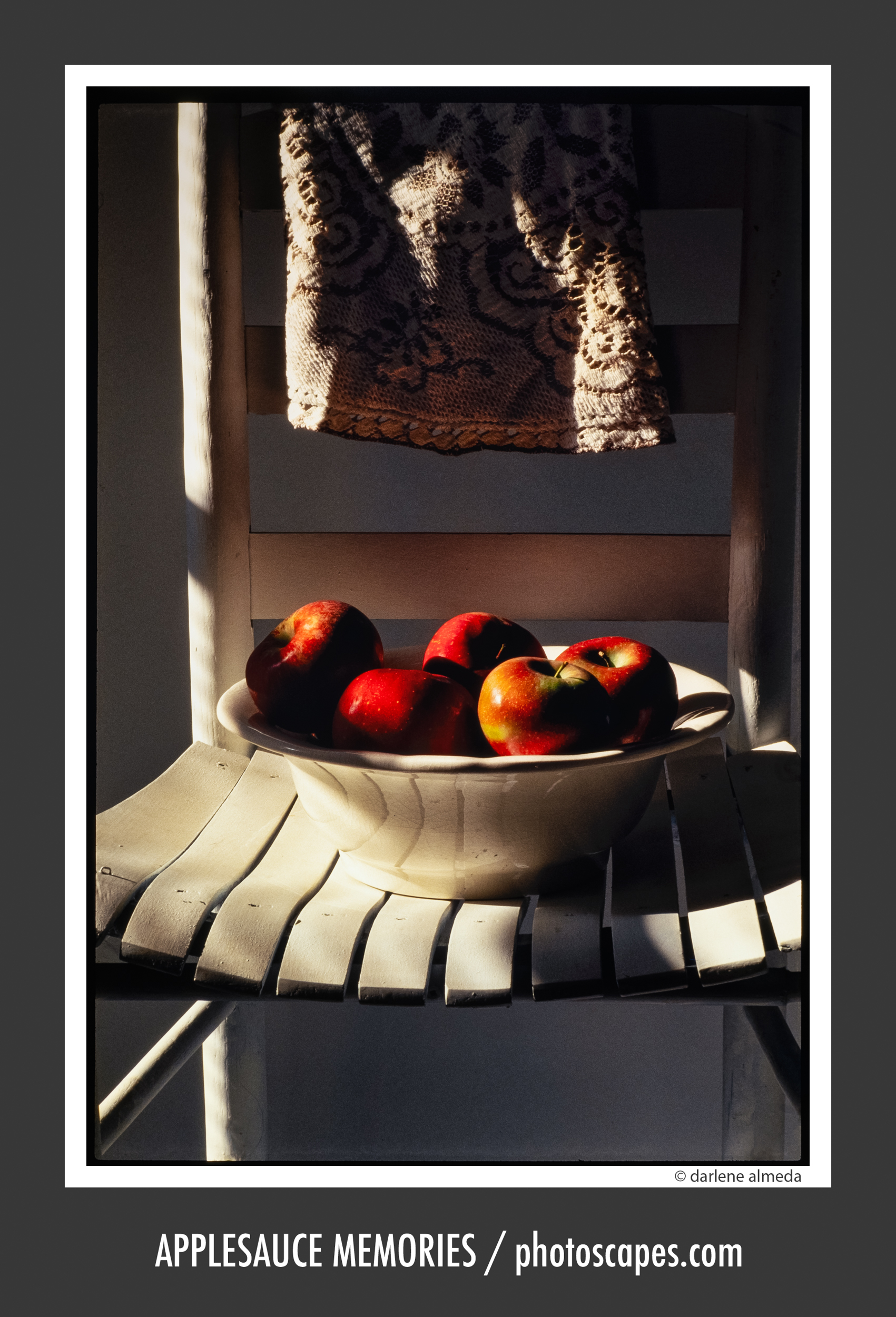
she lives in small things
apples in a shallow bowl
morning window light
a photograph shaped by light, memory, and the sweetness of small things
I spent a great deal of time with my maternal grandparents growing up. My mother was their only child together, and my grandmother had a son from a previous marriage who my grandfather raised as his own. That son, my uncle, would become one of the most influential men in my life, alongside my grandfather.
I lost my father at the age of eight, not to death, but to abandonment. Lucky for me, I had Gramps and my uncle.
But this photograph belongs to my grandmother.
I called her Gram.
She was a strict woman, shaped by her upbringing. Her father was a Native American tomato farmer from the New Jersey Pine Barrens, and her mother was a German immigrant. I was always fascinated by that pairing. My uncle once told me his grandmother never spoke English, only German, and I often wondered how they understood one another.
What I knew for certain was this: Gram spoke through her cooking.
Supper was served in the middle of the day, always a full spread of home-cooked food made from memory, not recipes. She canned fruits and vegetables, and I was often sent down to the root cellar to fetch what she needed.
When she asked for applesauce, I would try my best to open the jar on the way back up those cellar stairs. I never could. It is a wonder I did not break a tooth trying. That applesauce was my favorite, and somehow it tasted even better for the effort.
As I grew older, I spent more time with my grandfather. He was an artist and a baseball fan, which made him my kind of person. I can still hear him yelling at the radio when the Phillies disappointed him, and I remember the smell of oil paint as he worked on his seascapes in the basement.
I would sit nearby, usually on a stack of National Geographics, just watching.
He photographed with a Rolleiflex and encouraged me to become an artist.
Lucky me, again.
He passed away when I was twelve, just a week after I lost a puppy. It was a difficult summer. Gram lived on for many years after, and she passed away the week after my son was born. I named my son after Gramps, and also Thomas Jefferson.
This photograph came the year before she passed.
I had a small studio space in my home and had recently married. I spent my time there making portraits and still life images, the two things I loved most then. One afternoon, I walked into the room and saw the window light falling across a chair in a way I could not ignore.
The bowl was made by my sister. The cloth draped above was one Gram had given me. There was a bag of apples sitting on the counter from a recent trip to the store.
And just like that, I thought of her applesauce.
Not just the taste of it, but the feeling of it.
The cellar. The jars. The stubborn lids.
The quiet happiness of those small moments.
I placed the apples in the bowl, and the photograph made itself.
Some images are constructed. Others are remembered into existence.
This one was both.
How about you?
Have you ever made a photograph from a memory that refuses to let go?
I think you can.
Reflections
Photography does not always begin with a camera.
Sometimes it begins with something much quieter, a memory, a feeling, a moment that lingers long after it has passed.
What mattered here was not the apples or the bowl, but what they carried. The objects were simply a way in, a bridge between the present and something I could not revisit any other way.
Light does the same thing.
It reveals, but it also recalls.
If you find yourself wanting to make more meaningful photographs, start there.
Not with gear, not with settings, but with something that stays with you. Something small. Something honest.
Then wait for the light.