
Exploring atmosphere, interpretation, and artistic expression through the enduring influence of photographic Pictorialism.
What Is Pictorialist-Influenced Photography?
Pictorialist-influenced photography is an artistic approach that draws inspiration from the historical Pictorialist movement, emphasizing personal interpretation, atmosphere, mood, and the expressive possibilities of photographic materials and processes.
Rather than treating photography solely as a means of recording the visible world, this approach recognizes the photographer’s ability to transform a subject through composition, lighting, optical characteristics, tonal interpretation, and photographic technique.
Pictorialist-influenced photographs often possess qualities associated with drawing, painting, or other traditional visual arts. They may feature softened detail, expressive tonal relationships, subdued colors, atmospheric lighting, or an intentionally handcrafted appearance.
However, these characteristics are not requirements.
A photograph can demonstrate Pictorialist influence without resembling an antique print or employing historical photographic processes.
The defining connection is philosophical: the photograph is understood as an artistic interpretation rather than merely an accurate visual record.
Contemporary photographers may explore this approach through film, digital photography, pinhole cameras, historical lenses, alternative printing processes, or conventional equipment used with expressive intention.
The Historical Pictorialist Movement
Pictorialism developed during the late nineteenth century and became particularly influential around the turn of the twentieth century.
At a time when photography was often valued for its mechanical accuracy and documentary capabilities, Pictorialist photographers argued that the medium could also serve as a vehicle for individual artistic expression.
Their work challenged the assumption that a successful photograph should reproduce a subject with maximum clarity and precision.
Instead, they emphasized the photographer’s role in interpreting a scene and creating an image that communicated atmosphere, emotion, beauty, or personal vision.
Pictorialism was an international movement, with important developments in Europe and the United States.
Photographers such as Alfred Stieglitz, Edward Steichen, Gertrude Käsebier, Clarence H. White, Robert Demachy, and Heinrich Kühn helped establish photography as a serious artistic medium.
Their approaches varied considerably.
Some favored soft-focus lenses and atmospheric compositions. Others experimented with photographic printing processes that allowed substantial control over texture, tone, and the appearance of the finished print.
Among the processes associated with Pictorialism were gum bichromate, bromoil, and platinum printing, although these methods were neither exclusive to the movement nor practiced by every Pictorialist.
The gum bichromate process, for example, allowed photographers to manipulate the appearance of an image through the application and development of pigmented coatings. Such methods provided opportunities for individual interpretation beyond conventional photographic printing.
Pictorialist photographers also explored composition, lighting, subject selection, and tonal relationships as important elements of artistic expression.
The movement’s influence began to diminish during the early twentieth century as modernist approaches, particularly straight photography, gained prominence.
Straight photography emphasized the distinctive visual capabilities of the photographic medium, including clarity, detail, and precise rendering, rather than attempting to emulate the appearance of other art forms.
Nevertheless, Pictorialism played an important role in the recognition of photography as an expressive art.
Its influence continues wherever photographers use the medium to communicate a personal interpretation of the world.
Characteristics of Pictorialist-Influenced Photography
Although there is no single visual formula for Pictorialist-influenced photography, several characteristics frequently connect contemporary work to the historical movement.
—
Atmosphere and Emotional Expression
Atmosphere is among the most recognizable qualities associated with Pictorialist photography.
Fog, mist, diffused illumination, silhouettes, subdued tonal relationships, and carefully controlled contrast can transform ordinary subjects into images that suggest emotion or mystery.
A landscape may become a meditation on solitude rather than a straightforward description of a location.
A portrait may emphasize the subject’s emotional presence rather than precise facial detail.
A still life may communicate memory, tranquility, or the passage of time through its arrangement and lighting.
The objective is not necessarily to obscure information, but to direct attention toward the expressive qualities of the photograph.
—
Soft Focus and Selective Detail
Historical Pictorialists frequently experimented with lenses and techniques that reduced the sharp, highly descriptive appearance associated with conventional photography.
Soft-focus lenses, diffusion, controlled focus, and other optical characteristics could create luminous highlights, softened transitions, or a sense of atmospheric depth.
These effects remain available to contemporary photographers through historical lenses, modern specialty optics, pinhole photography, and other methods.
However, softness alone does not make a photograph Pictorialist-influenced.
It becomes meaningful when it contributes to the image’s artistic intention.
A deliberately softened photograph may emphasize memory, emotion, or atmosphere, while a sharply rendered photograph can express similar ideas through composition, light, and tonal interpretation.
—
Tonal Interpretation
Pictorialist photographers often placed considerable emphasis on the relationships between light and dark.
Rather than reproducing every available detail, they might simplify tonal information, emphasize selected areas, or allow portions of the image to merge into shadow.
Subtle gradations, luminous highlights, restrained contrast, and expressive dark values can contribute to a photograph’s emotional character.
Monochromatic and warm-toned photographs are frequently associated with historical Pictorialism, partly because of the photographic materials and printing processes available during the movement.
Contemporary Pictorialist-influenced photography, however, is not restricted to black and white or sepia-toned imagery.
Color can be equally expressive when its relationships support the intended atmosphere.
—
The Photographic Process as an Expressive Tool
One of Pictorialism’s enduring contributions was the recognition that photographic materials and processes could influence the expressive character of an image.
Historical photographers experimented with lenses, negatives, printing papers, pigments, and chemical processes to achieve their desired results.
Contemporary photographers may explore similar ideas through film grain, unusual exposure and development combinations, historical optical designs, pinhole photography, alternative processes, or digital interpretation.
The resulting characteristics may include softened detail, pronounced grain, altered color relationships, unusual contrast, or distinctive rendering of highlights and shadows.
These qualities are not inherently artistic simply because they differ from conventional photographic appearance.
Their significance depends on how they contribute to the photograph’s overall expression.
—
Composition and Artistic Interpretation
Pictorialist-influenced photography places considerable importance on the photographer’s decisions about what to include, emphasize, simplify, or exclude.
Composition may be carefully arranged, as in a studio still life, or discovered through observation, as in landscape and environmental photography.
The photographer may use negative space, repeated forms, visual balance, or symbolic subject matter to create an image that suggests more than its literal content.
The emphasis is on personal vision rather than adherence to a particular compositional formula.
Pictorialist-Influenced Photography Through My Lens
My interest in photography has always extended beyond the mechanical reproduction of a subject.
During my early years as a photographer, I became increasingly interested in what could happen when I experimented with the camera, film, lenses, and photographic processes.
I wanted to discover what photography could express beyond ordinary representation.
Some experiments involved pushing film beyond its rated sensitivity to explore the resulting changes in grain, color, and tonal relationships.
Others involved alternative optical methods, including pinhole photography and historical lenses.
As my photographic practice developed, I continued exploring different cameras and processes, eventually combining older photographic equipment with contemporary digital technology.
I have never believed that artistic expression depends upon using the newest equipment or achieving the greatest possible technical precision.
A photograph can be technically accomplished without being particularly expressive, just as an image made with unconventional equipment or an imperfect optical system can communicate something deeply meaningful.
For me, the choice of equipment and process should serve the photograph rather than determine its artistic value.
The four photographs that follow illustrate different approaches to Pictorialist-influenced photography. They span several decades of my photographic life and demonstrate how the same interest in interpretation and expression can continue through changing technologies.
Selected Photographs
top image
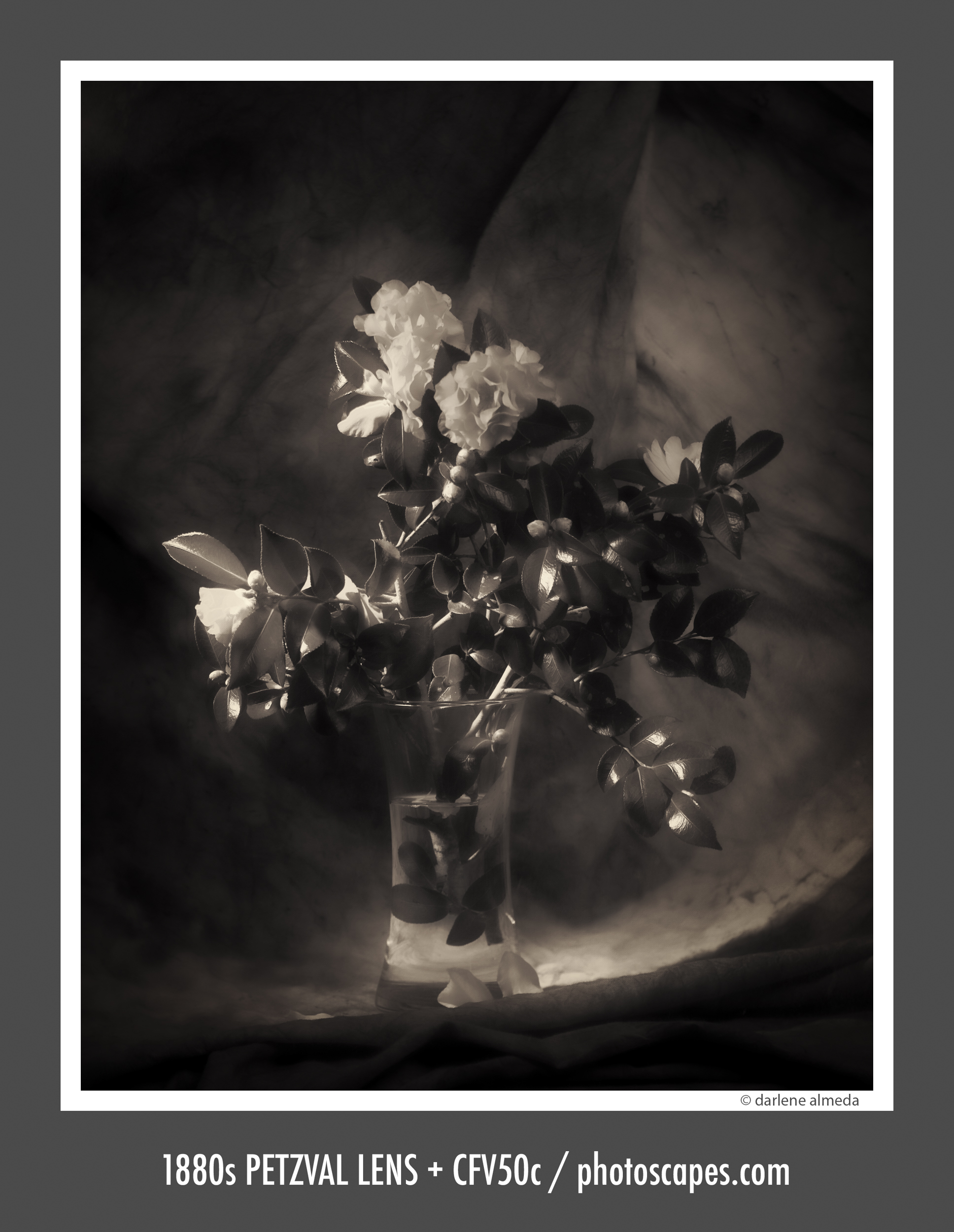
An 1880s Petzval Lens with a Hasselblad CFV50c
Historical optics, contemporary technology, and expressive botanical photography.
This botanical still life combines a nineteenth-century Petzval lens with a contemporary Hasselblad digital back.
I made the photograph using a Sinar Norma view camera equipped with a Sinar shutter. The Petzval lens had been adapted to a Graphic lens board, which I mounted to the Sinar using a Graphic-to-Sinar lens board adapter.
The lens also has custom-made Waterhouse stops, allowing aperture selection through interchangeable plates.
For illumination, I used a single studio strobe, but only its modeling light rather than the flash.
The resulting photograph presents a small arrangement of blossoms emerging from a dark, softly rendered background.
The luminous flowers and gradual transitions between light and shadow create an atmosphere that recalls aspects of historical art photography.
The Petzval lens contributes its distinctive optical rendering, while the composition and lighting establish the image’s expressive character.
What interests me about this photograph is the relationship between photographic technologies separated by more than a century.
The historical lens provides one set of visual possibilities, while the digital back allows those characteristics to be explored through a contemporary workflow.
The photograph is not intended to reproduce an antique image.
Instead, it demonstrates how an older optical instrument can remain a useful means of artistic interpretation when placed in the hands of a contemporary photographer.
Its Pictorialist influence lies not simply in the age of the lens, but in the deliberate use of optical rendering, light, and tonal relationships to create atmosphere.

In a Dream
Pinhole photography, atmosphere, and the suggestion of memory.
I made In a Dream using a Hasselblad 501CM fitted with a pinhole rather than a conventional photographic lens.
The composition brings together a gramophone, a mandolin, and surrounding vegetation in a setting filled with light and shadow.
The pinhole’s characteristic rendering softens fine detail and produces a distinctive relationship between illuminated areas and darker forms.
Rather than describing every surface precisely, the image encourages the viewer to experience the scene as an atmosphere.
The objects themselves suggest music, memory, and an earlier time, while the softened rendering contributes to the photograph’s dreamlike character.
Pinhole photography provides an interesting contemporary parallel to certain expressive goals associated with historical Pictorialism.
Although pinhole imaging is not inherently Pictorialist, its optical characteristics can be used to reduce descriptive precision and emphasize mood.
In this photograph, the pinhole is not simply an alternative method of recording the scene.
It becomes an essential part of how the subject is interpreted.
The result is less a literal description of objects in a garden than an impression of a remembered or imagined moment.
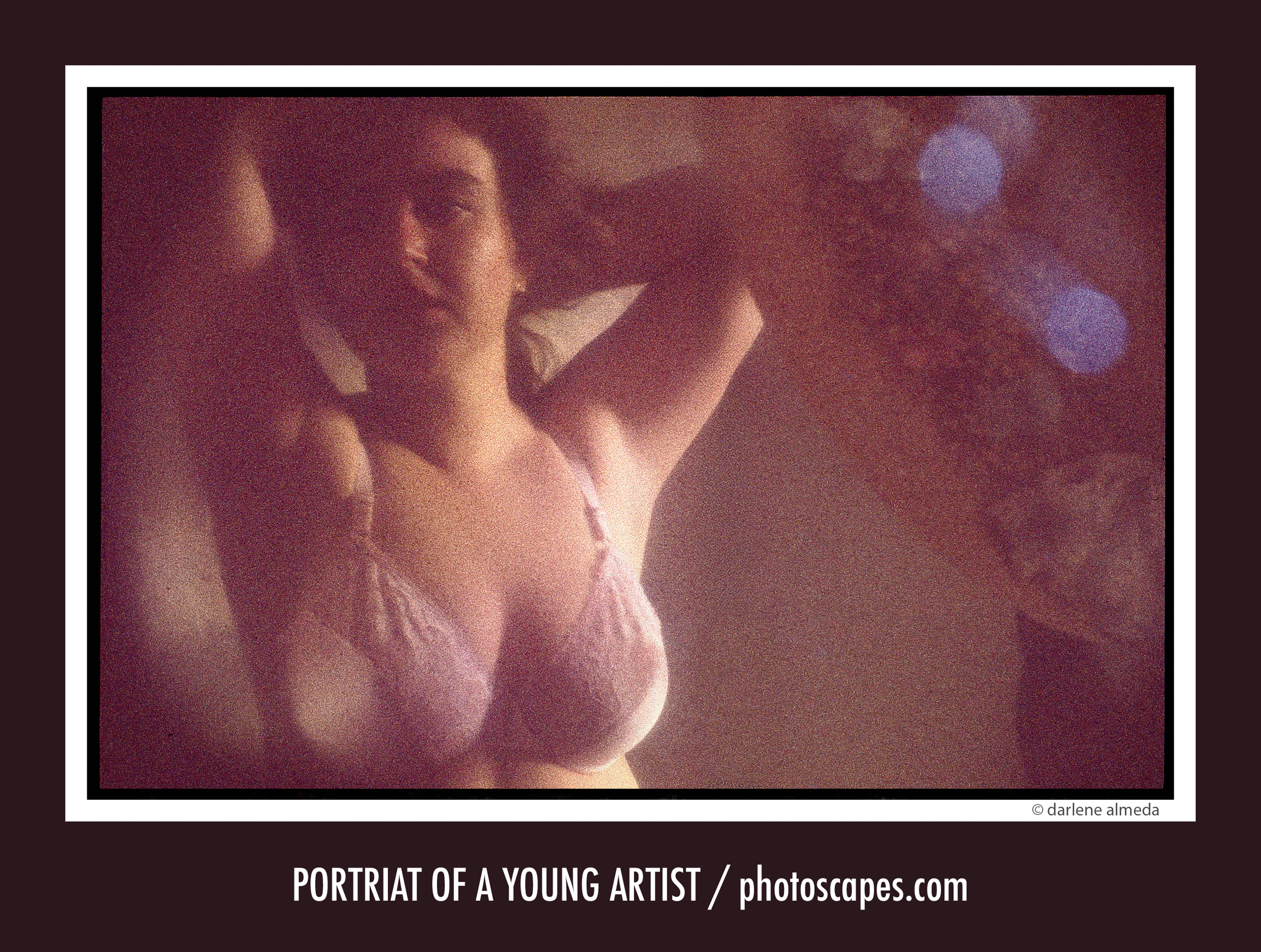
Portrait of a Young Artist
Experimental film processing, reflection, and personal expression.
I made Portrait of a Young Artist in the early 1980s, during a period when I was exploring photography beyond its conventional descriptive possibilities.
Using a Canon AE-1 and Scotch Chrome 1000 color transparency film pushed to ISO 4000, I was deliberately experimenting with the visual effects that could be produced by extending the film beyond its nominal sensitivity.
The photograph is a self-portrait, although the camera was not pointed directly at me. Instead, I photographed my reflection in a mirror.
There is a certain irony in that arrangement.
At the time, I was at a crossroads in my artistic development, questioning where I wanted to go and experimenting with what the camera might allow me to express.
The mirror provided a literal reflection, while the photograph itself became a reflection of that period in my life.
The pronounced grain, softened detail, and unusual color relationships were part of my exploration of the photographic medium.
Rather than treating these characteristics as technical defects, I was interested in how they might contribute to an image’s expressive qualities.
This approach shares an important philosophical connection with historical Pictorialism.
Although the techniques differ, both involve looking beyond photography’s ability to reproduce appearances and considering how the photographic process itself can become a means of artistic interpretation.
Looking back, I see this photograph as more than an experiment with film.
It represents a young artist discovering that photography could be as much about exploring personal ideas and emotions as recording the world in front of the camera.
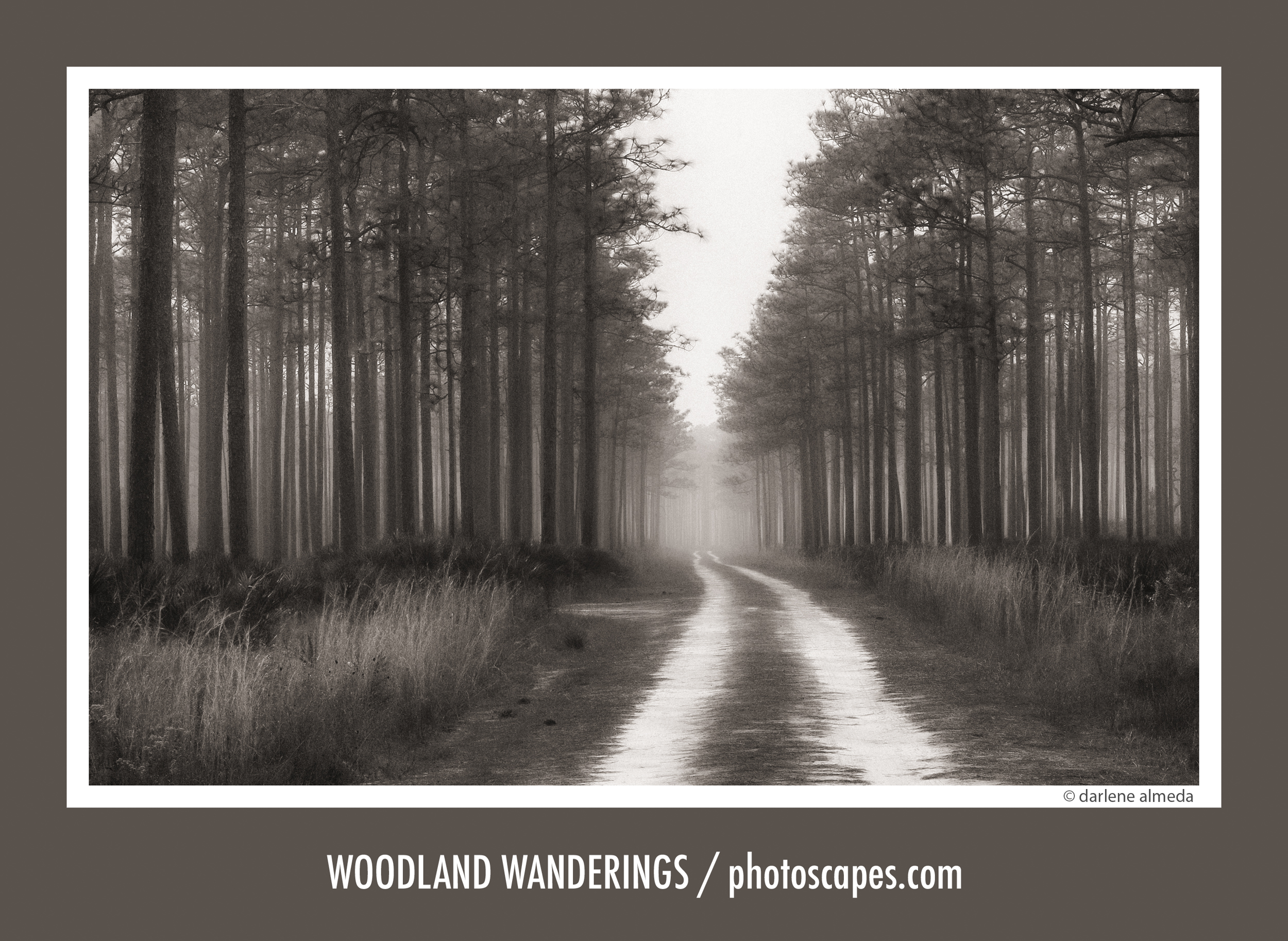
Woodland Wanderings
Contemporary digital photography and atmospheric landscape interpretation.
Woodland Wanderings is one of the more recent photographs in this selection, made with a Hasselblad 907X and XCD 45P lens.
A narrow road winds through a stand of tall trees, gradually disappearing into the mist.
The repetition of the tree trunks establishes a strong visual rhythm, while the pale road draws the viewer into the composition.
As the landscape recedes, atmospheric conditions soften distant detail and reduce tonal contrast.
The monochromatic interpretation emphasizes the relationship between the darker trees, the luminous road, and the gradually dissolving background.
Unlike the other photographs in this selection, Woodland Wanderings does not rely on historical optics, experimental film processing, or pinhole imaging.
Its Pictorialist influence emerges primarily through atmosphere, tonal relationships, and composition.
The photograph demonstrates that contemporary digital equipment can be used to explore the same expressive concerns that interested photographers more than a century ago.
The subject remains recognizable, but the mist and tonal interpretation encourage a more contemplative experience.
For me, the photograph is less about documenting a road through the woods than communicating the quiet mystery of a landscape gradually disappearing from view.
Pictorialist-Influenced vs. Painterly Photography
Pictorialist-influenced photography and painterly photography share many visual characteristics, but they describe different aspects of photographic expression.
Painterly photography is a broad stylistic approach that draws upon the visual principles of painting, including composition, color harmony, tonal modeling, texture, and atmosphere.
Pictorialist-influenced photography draws more specifically upon the historical movement that advocated photography as an expressive art and explored ways of extending the medium beyond straightforward description.
A photograph may be painterly without demonstrating a particularly strong connection to Pictorialism.
For example, a sharply rendered studio still life may possess painterly qualities through its carefully controlled light and composition.
A Pictorialist-influenced photograph may also be painterly, particularly when its atmosphere, tonal relationships, or optical rendering resemble traditional artistic media.
The distinction is primarily one of historical influence and artistic emphasis rather than an absolute difference in appearance.
Pictorialist-Influenced vs. Impressionistic Photography
Pictorialist-influenced photography also overlaps with impressionistic photography.
Both approaches may emphasize atmosphere, subjective experience, and the reduction of descriptive detail.
However, impressionistic photography generally emphasizes fleeting visual impressions, perception, and the suggestion of a moment rather than its precise representation.
It may employ intentional camera movement, selective focus, diffusion, unusual optics, or other techniques that create a less literal appearance.
Pictorialist-influenced photography encompasses a broader historical relationship between artistic intention and the photographic process.
It may involve atmospheric composition, but it can also emphasize experimental printing, expressive portraiture, unusual tonal interpretation, or the deliberate use of photographic materials.
A photograph may belong comfortably within both styles.
These distinctions are most useful when they help explain how and why a photographer created a particular image.
Historical Techniques and Contemporary Possibilities
The photographic tools available today would have been unimaginable to the earliest Pictorialists.
Digital sensors, image-processing software, contemporary optical systems, and modern printing technologies provide extensive opportunities for controlling the appearance of a photograph.
Yet many of the artistic questions remain remarkably familiar.
How much detail should be revealed?
What should remain in shadow?
How can the characteristics of a lens or photographic process contribute to the subject’s interpretation?
What happens when technical precision is no longer the principal objective?
Contemporary photographers can explore these questions through many different methods.
Some work with historical lenses or alternative photographic processes. Others use conventional digital equipment and rely primarily on composition, light, and tonal interpretation.
Neither approach is inherently more authentic.
What matters is whether the chosen methods contribute meaningfully to the photographer’s artistic intention.
Historical Pictorialism was never simply a collection of visual effects.
Its greater significance was the assertion that photography could be shaped by imagination, interpretation, and personal vision.
That principle remains relevant regardless of the equipment used.
The Value of Experimentation
Experimentation has been an important part of my photographic development.
I have worked with many different cameras, lenses, films, and processes throughout my career, often because I wanted to understand what possibilities they offered.
Sometimes an experiment produces exactly the result I anticipated.
Other times, the outcome introduces something unexpected that suggests a different direction.
Both experiences can be valuable.
I believe photographers benefit from learning the technical principles of their medium, but I also believe there is considerable value in exploring what happens when conventional expectations are set aside.
Understanding how a process works provides the foundation for deciding when and why to use it differently.
My early experiments with pushed film, later explorations with pinhole photography, and continued interest in historical lenses all reflect that curiosity.
They also remind me that the most meaningful discoveries do not necessarily require elaborate equipment or complicated methods.
Sometimes a different lens, an unconventional exposure, or a willingness to accept an unexpected result is enough to reveal a new way of seeing.
Final Thoughts
Pictorialist-influenced photography represents an enduring connection between the history of photography and the expressive possibilities of the medium today.
The historical Pictorialists helped establish the idea that photography could be more than a mechanically accurate record of the visible world.
They encouraged photographers to consider atmosphere, emotion, interpretation, and the artistic possibilities of photographic materials and processes.
Contemporary photographers continue to explore these ideas through methods ranging from nineteenth-century optical designs to modern digital cameras.
For me, the influence of Pictorialism is not about recreating the appearance of the past.
It is about remaining open to the expressive possibilities of photography and recognizing that technical precision is only one of the many qualities that can contribute to a successful image.
A photograph may be soft or sharply rendered, monochromatic or colorful, traditionally produced or digitally interpreted.
What matters is the photographer’s intention and the relationship between the chosen methods and the resulting image.
The enduring lesson of Pictorialism is that photography becomes an expressive art when the photographer contributes something beyond the appearance of the subject.
words & images © darlene c. almeda / photoscapes.com