The art of using light, color, composition, and atmosphere to create photographs with the expressive qualities of painting.
What Is Painterly Photography?
Painterly photography is a photographic style that draws upon the visual language of painting. Rather than simply recording the appearance of a subject, it emphasizes the expressive relationships between light, shadow, color, form, texture, and composition.
A painterly photograph may resemble a classical oil painting, a delicate watercolor, or a contemporary work of art. However, the style is not defined by its resemblance to any particular painting technique or historical period.
Its defining characteristic is the photographer’s deliberate use of visual elements to create an image that feels composed, expressive, and aesthetically unified.
Painterly photography can be found across many photographic genres, including still life, portraiture, landscape, architecture, botanical photography, and fine art.
It does not necessarily require soft focus, unusual lenses, digital textures, or extensive post-processing. A sharply focused photograph made with conventional equipment can possess distinctly painterly qualities through its lighting, tonal relationships, and composition alone.
In many cases, the painterly character of an image is established before the exposure is made.
The Relationship Between Painting and Photography
Photography and painting have influenced one another since photography’s earliest years.
Painters have traditionally relied on composition, color, light, shadow, and perspective to translate three-dimensional subjects onto a two-dimensional surface. Photographers work with many of these same visual principles, although their tools and methods differ.
During the nineteenth century, some photographers began deliberately exploring the artistic possibilities of the medium beyond its ability to record visible detail.
The Pictorialist movement, which became especially influential during the late nineteenth and early twentieth centuries, encouraged photographers to emphasize mood, atmosphere, and personal expression. Soft-focus lenses, specialized printing processes, and manipulation of photographic materials were among the techniques used to create images with qualities associated with drawing, etching, and painting.
Although Pictorialism helped establish photography as a medium of artistic expression, painterly photography is not limited to Pictorialist techniques.
Contemporary photographers may achieve painterly results through carefully controlled studio lighting, harmonious color relationships, restrained compositions, selective focus, or thoughtful digital processing.
The underlying connection remains the same: the use of visual relationships to communicate something beyond the literal appearance of a subject.
Characteristics of Painterly Photography
Painterly photographs vary widely in subject and appearance, but several visual qualities frequently contribute to the style.
—
Light and Shadow
Light is one of the most powerful tools available to both painters and photographers.
In painting, light and shadow are used to describe form, establish depth, direct attention, and create atmosphere. Photographers can accomplish similar effects through the direction, quality, and placement of illumination.
A single carefully positioned light source may reveal the shape of an object more effectively than several lights intended to illuminate every visible surface.
Shadows are particularly important because they help establish volume and dimensionality.
The gradual transition between illuminated and shaded areas allows a two-dimensional image to suggest the physical form of a three-dimensional subject.
This process is often described as tonal modeling.
Painterly lighting may be soft and delicate or dramatic and directional. What matters is how the relationships between light and dark contribute to the photograph’s expressive character.
—
Color Harmony
Painters frequently organize compositions around relationships between colors rather than treating each color independently.
Photographers can apply the same principles by considering complementary colors, analogous palettes, warm and cool relationships, and the visual balance of saturated and muted areas.
A photograph does not need unusually vivid colors to be painterly.
Subtle variations within a limited palette can be equally expressive, particularly when the colors reinforce the mood or character of the subject.
In still life photography, the choice of background, supporting objects, and illumination can establish color relationships before the photograph is made.
In landscape photography, those relationships may be discovered through careful observation of natural light and environmental conditions.
—
Composition and Visual Balance
Painterly photography often emphasizes the deliberate arrangement of visual elements.
Shapes, lines, textures, negative space, and areas of visual weight are organized to create a unified composition.
The photographer may arrange objects within a studio setting or select a viewpoint that brings existing elements into a meaningful relationship.
The objective is not necessarily symmetry or perfection.
A composition can be intentionally asymmetrical, irregular, or visually complex while maintaining a sense of balance.
Like painting, photography involves deciding not only what belongs within the frame, but also what should be excluded.
—
Texture and Surface
Texture can contribute significantly to the painterly character of a photograph.
Weathered wood, translucent flower petals, ceramic glazes, fabric, foliage, and other surfaces provide visual information that can be emphasized through lighting and composition.
Unlike a painting, where texture may be created through the physical application of pigment, photographic texture is generally derived from the subject, the characteristics of the photographic medium, or subsequent image processing.
A painterly photograph does not need to imitate brushstrokes or canvas texture.
Often, the careful rendering of an existing surface provides all the tactile interest the composition requires.
—
Atmosphere and Mood
Painterly photography frequently communicates a sense of atmosphere that extends beyond the literal subject.
A quiet interior, an abandoned building, a flower emerging from darkness, or a landscape beneath a dramatic sky may suggest feelings of solitude, tranquility, mystery, or nostalgia.
These qualities can arise from the relationship between subject matter, light, color, and composition.
Atmosphere does not necessarily require softness or reduced detail.
A sharply rendered photograph can be deeply atmospheric when its visual elements work together to establish a particular mood.
Painterly Photography Through My Lens
My interest in painterly photography comes naturally from a career spent working with light, composition, and color.
Throughout my years in commercial photography, I learned that a successful photograph often depends less on the quantity of equipment used than on understanding what each element contributes to the image.
This is particularly true in still life photography, where the photographer has considerable control over the subject, lighting, background, and arrangement.
I generally prefer to begin with a simple composition and introduce additional elements only when they serve a purpose.
The same approach applies to lighting. A single carefully positioned source may provide everything necessary to describe a subject’s form and establish the intended atmosphere.
Painterly photography appeals to me because it encourages deliberate observation.
Rather than asking how much can be added to a photograph, I often find myself considering how little is needed to communicate the subject effectively.
The following photographs illustrate several different approaches to painterly photography, from controlled studio lighting and color harmony to atmospheric landscapes and expressive botanical studies.
Selected Photographs
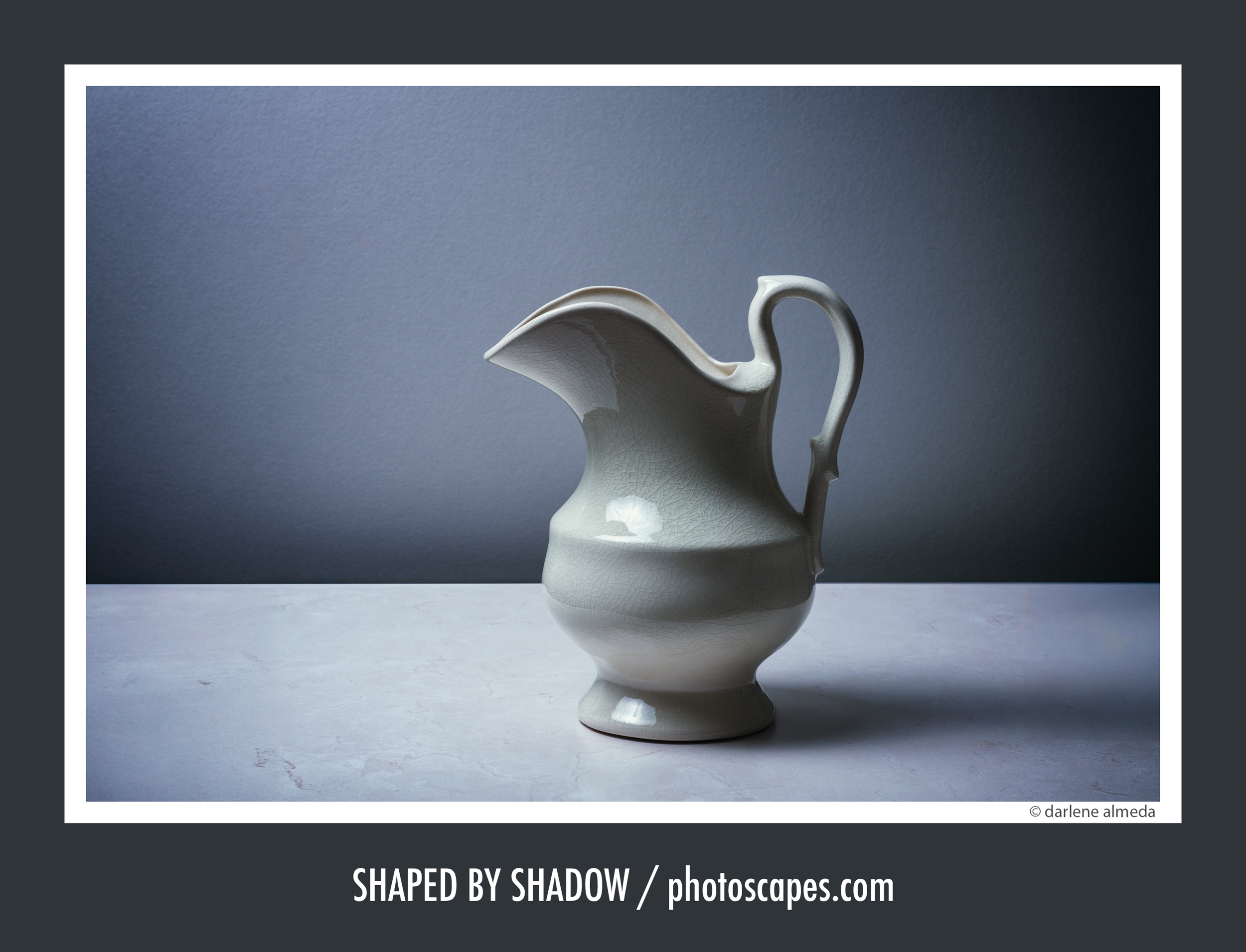
Shaped by Shadow
Painterly still life through the modeling of light and shadow.
In Shaped by Shadow, I photographed a white ceramic pitcher using a Sony A7 digital camera and a single studio strobe fitted with a Halo softbox.
The light was positioned above and to the left of the subject, while the light table helped open the shadows without eliminating the tonal transitions that give the pitcher its three-dimensional appearance.
The composition is intentionally restrained. A single object, a simple background, and a limited palette allow the viewer to concentrate on the relationship between light, form, and shadow.
For the backdrop, I used one of my favorite inexpensive studio solutions: a sheet of gray matte board supported by flexible clamps.
I have used this arrangement for years because it is easy to reposition, requires very little space, and provides a versatile background for tabletop photography. Neutral gray is especially useful because its appearance can be shifted toward warmer or cooler tones during post-processing when the photograph calls for a different color relationship.
As the light travels across the pitcher, it reveals the outward flare of the lip, the narrowing waist, the rounded body, and the graceful curve of the handle.
The highlights establish where the light strikes the surface, but the gradual transition into shadow creates the sense of volume.
This relationship between light and dark is fundamental to traditional painting. Artists have long used tonal modeling to suggest depth and dimensionality on a flat surface.
In photography, the same principle can be achieved through the careful placement, size, and quality of the light source.
The photograph demonstrates that a painterly appearance does not require soft-focus lenses, artificial textures, or elaborate digital manipulation. It can emerge entirely from thoughtful illumination and composition.
I originally created this photograph as part of my Lighting 101 educational series, where I explored the role of shadows in describing photographic form.
Related lesson: Lighting 101.06 – Shadows
Behind the Scenes: Shaped by Shadow
A single studio strobe fitted with a Halo softbox illuminates the ceramic pitcher from above and to the left. The light table helps lift the shadow values while preserving the gradual tonal transitions that define the object’s shape.
The gray matte board backdrop is supported by inexpensive flexible clamps, demonstrating that a simple and practical lighting arrangement can produce sophisticated painterly results.
—
Three Pears
Painterly still life through color harmony, form, and composition.
Three Pears illustrates how a carefully arranged still life can develop painterly qualities through the relationship between color and form.
The warm yellow tones of the pears contrast with the cooler blue-green background, establishing a complementary color relationship that gives the composition both visual interest and harmony.
The pears differ slightly in shape, orientation, and position, creating a gentle rhythm across the image.
Their arrangement feels deliberate without appearing rigid.
The simplicity of the subject allows the viewer to appreciate the subtle differences in surface texture, color, and reflected light.
This photograph demonstrates that painterly photography does not require an elaborate subject or unusual photographic effects.
Ordinary objects can become expressive when their visual relationships are thoughtfully considered.
—
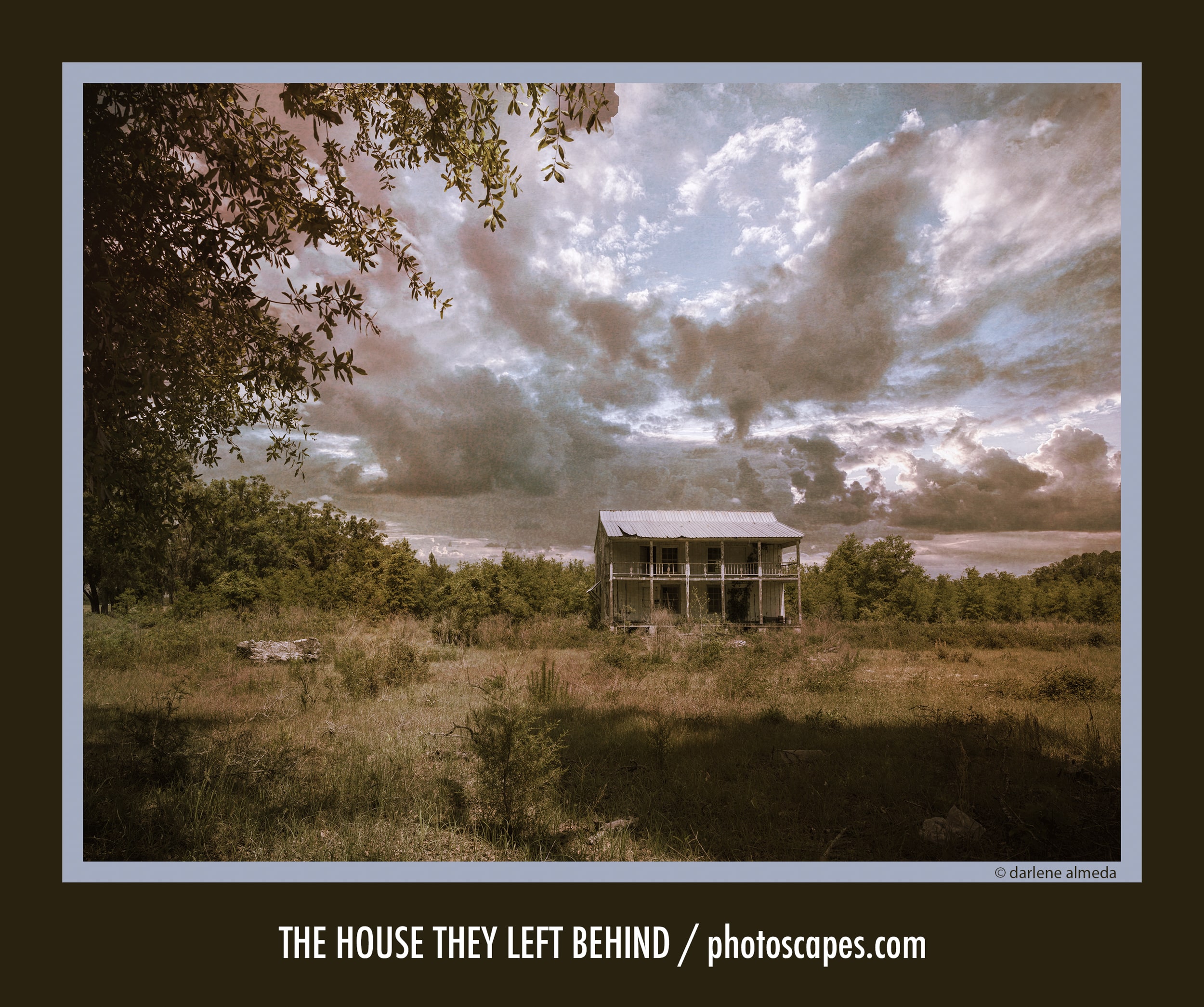
The House They Left Behind
Painterly landscape through atmosphere, color, and visual storytelling.
In The House They Left Behind, a weathered house sits within a landscape of subdued earth tones, surrounding vegetation, and an expressive sky.
The building occupies a relatively small portion of the composition, allowing the environment to contribute significantly to the image’s character.
The relationship between the structure and its surroundings establishes a sense of place while suggesting the passage of time.
The photograph’s painterly qualities emerge from the harmony of its colors, the organization of its shapes, and the atmospheric relationship between the foreground, building, and sky.
Unlike a studio still life, where individual elements can be arranged, landscape photography requires the photographer to discover an effective composition within an existing environment.
Careful framing, perspective, and attention to changing light allow those elements to become visually unified.
This photograph demonstrates how painterly qualities can be found in ordinary or overlooked places without substantially altering their recognizable appearance.
—
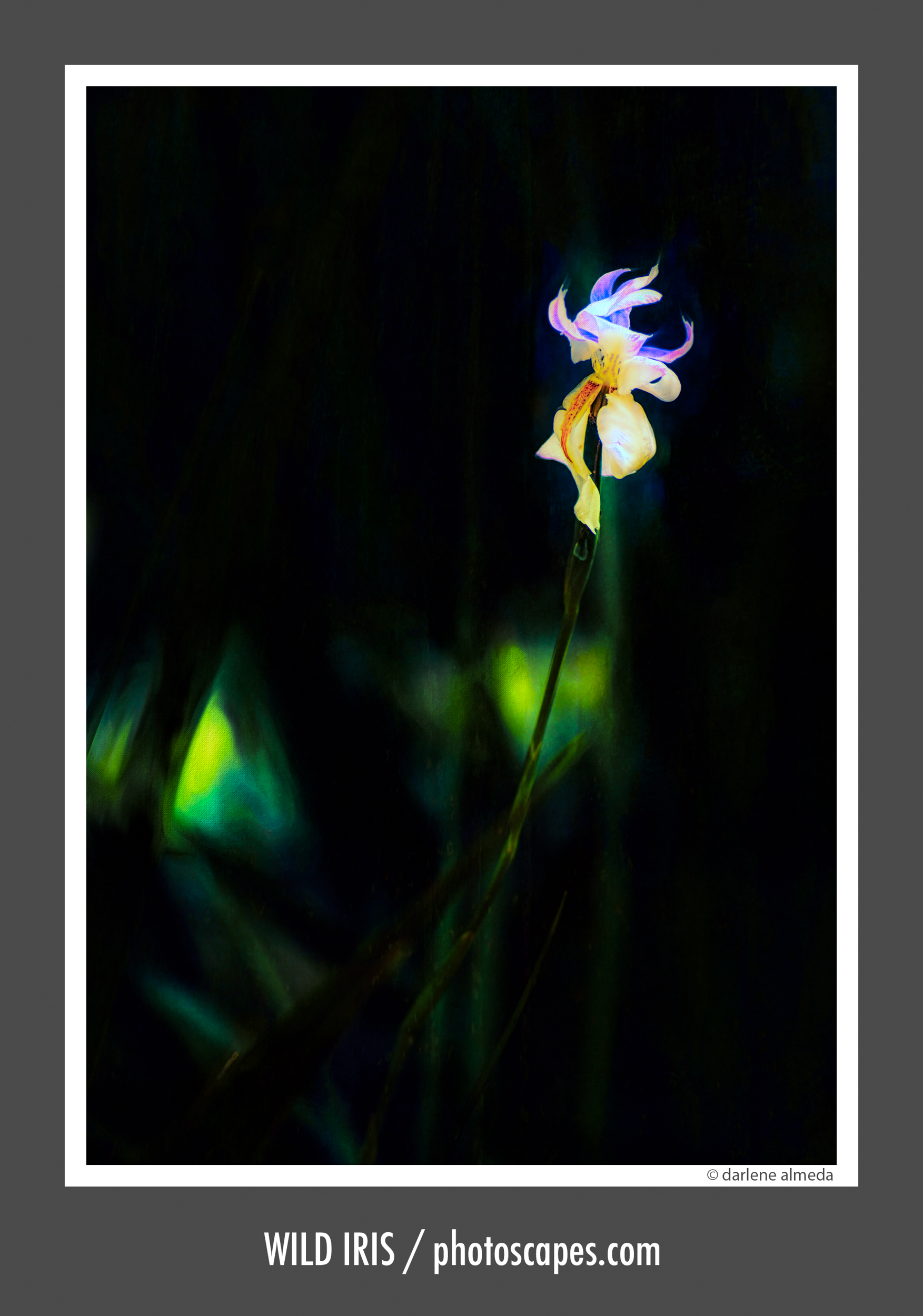
Wild Iris
Painterly botanical photography through expressive color and negative space.
Wild Iris offers a more expressive interpretation of painterly photography.
The illuminated flower emerges from a predominantly dark background, allowing its color and delicate structure to become the principal focus of the composition.
Areas of luminous green and blue provide visual contrast while creating a sense of movement and rhythm.
The extensive negative space is an essential part of the image.
Rather than filling the frame with detail, the composition allows the flower to occupy a relatively small, carefully considered area.
The resulting photograph has a contemporary painterly quality that differs considerably from the classical still life approach demonstrated in Shaped by Shadow.
Together, these images illustrate how painterly photography can encompass both restrained tonal modeling and expressive relationships between color, light, and space.
Painterly Photography vs. Impressionistic Photography
Painterly and impressionistic photography share certain characteristics, but they are not interchangeable.
Painterly photography is a broad style that draws upon the visual principles of painting, including composition, tonal modeling, color harmony, texture, and atmosphere.
Impressionistic photography places greater emphasis on subjective perception, fleeting impressions, atmosphere, and the suggestion of visual experience rather than precise description.
Impressionistic photographs may employ soft focus, intentional camera movement, unusual optical characteristics, or other techniques that reduce literal detail.
Painterly photographs, however, may be sharply focused and technically precise.
A carefully illuminated ceramic pitcher can be painterly because its light and shadow resemble the tonal modeling found in traditional painting.
A softly rendered landscape may be both painterly and impressionistic when its composition and atmosphere evoke the visual qualities associated with Impressionist painting.
The distinction is not absolute.
A photograph may incorporate characteristics of several styles simultaneously, and these classifications are most useful when they help explain the photographer’s visual intentions.
Painterly Photography and Post-Processing
Digital image processing has expanded the range of techniques available to photographers interested in painterly effects.
Color grading, selective contrast, tonal adjustments, texture overlays, and other methods can be used to create images that resemble particular painting traditions.
Some photographers deliberately transform photographs into images that imitate watercolor, oil painting, pastel, or other media.
These approaches can produce compelling results, but they represent only one aspect of painterly photography.
A painterly image does not have to be created through digital manipulation.
Its visual character may already be established through the selection of a subject, the direction of the light, the arrangement of objects, and the relationships between colors and tones.
For my own work, I generally prefer to establish as much of the intended visual character as possible during the photographic process.
Post-processing then becomes a means of refining the image rather than inventing its essential qualities.
The Importance of Simplicity
One of the most valuable lessons I learned during my years as a commercial photographer and instructor is that sophisticated results do not always require complicated methods.
A photographer who understands how light behaves can often accomplish more with one well-positioned source than with several lights used without a clear purpose.
The same principle applies to composition.
Adding more objects, colors, or visual effects does not necessarily make an image more expressive.
Sometimes the strongest photograph emerges when unnecessary elements are removed.
This is especially relevant to painterly photography, where relationships between light, form, and space often carry more visual importance than technical complexity.
My photograph Shaped by Shadow is a good example.
A single light, a simple background, and an ordinary ceramic pitcher provide an opportunity to explore the same principles of tonal modeling that painters have studied for centuries.
The sophistication lies in understanding how the elements work together, not in the number of tools required to produce the result.
Final Thoughts
Painterly photography is not defined by a particular camera, lens, photographic process, or degree of manipulation.
It is an approach to creating images that emphasizes the expressive possibilities of light, shadow, color, composition, and atmosphere.
A simple still life may reveal the sculptural qualities of an object through carefully controlled illumination.
A landscape may suggest the character of a place through its colors and atmospheric relationships.
A flower may become an expressive study of form and negative space.
Each photograph can be painterly in a different way.
For me, the appeal of painterly photography lies in its encouragement to observe more carefully and work more deliberately.
The photographer does not need to imitate a painting to benefit from the visual principles that painters have explored for centuries.
Sometimes the most painterly quality of a photograph is simply the thoughtful way its light, color, and composition have been brought together.
words & images © darlene c. almeda / photoscapes.com